
Contents
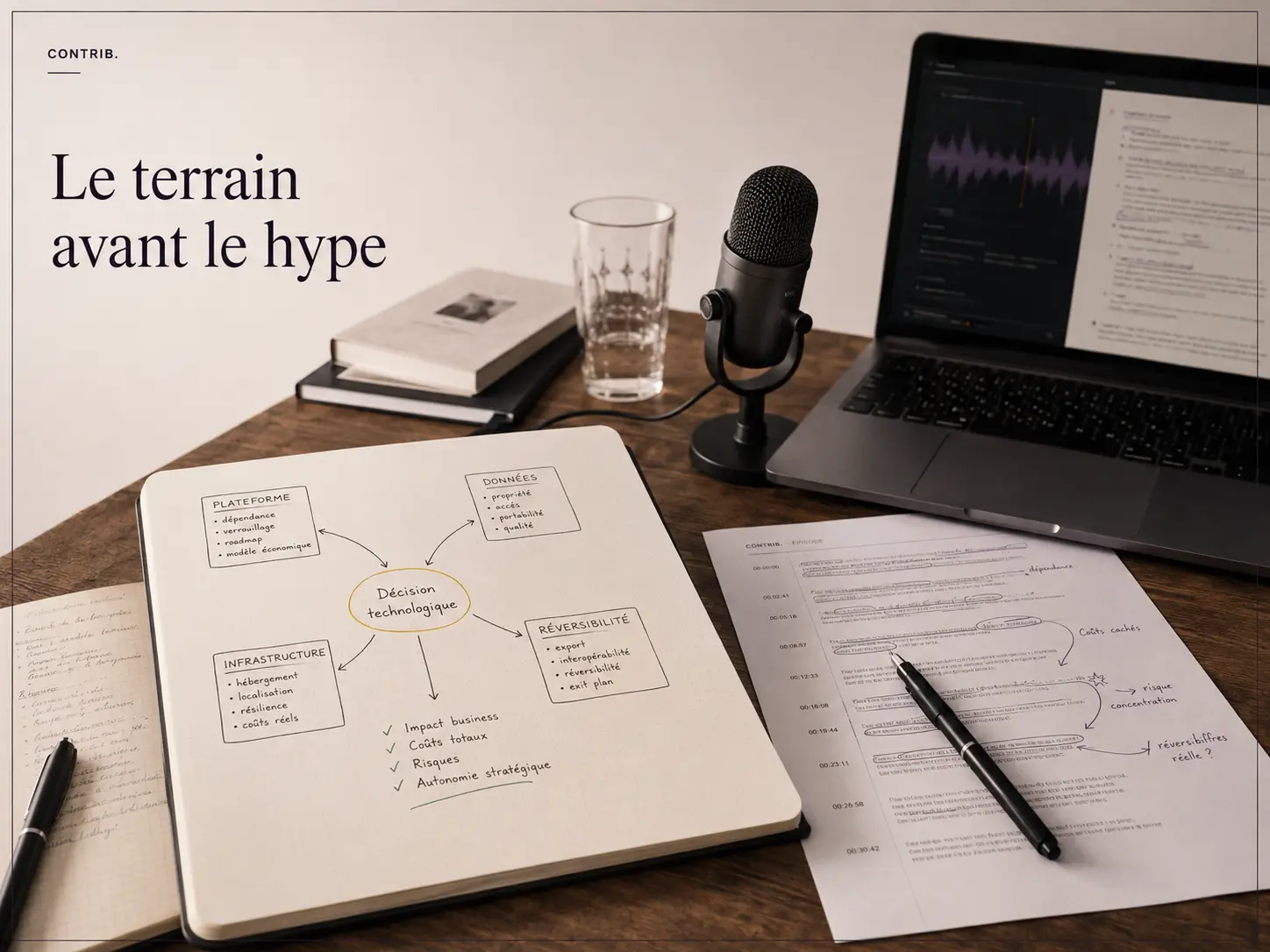
Transparency: I work at Profileo, where Thomas Rayrat is the CEO. This connection does not alter the following observation: Contrib. deserves attention for what it brings to the debate, not for the company surrounding it.
RSS
RSS sends new articles to the reader of your choice, without an algorithm or newsletter.
TL;DR
E-commerce doesn’t need yet another discussion about AI. It needs people who understand the real-world costs of their decisions.
With Contrib., Thomas Rayrat and Christophe Vidal offer a long-form format that connects technological announcements to their very concrete consequences: platform dependency, data control, infrastructure choices, the future of agencies, and Europe’s ability to maintain control. The media is produced by Friends of Presta, an association from the open-source community that understands both code and the real constraints faced by merchants.
E-commerce doesn’t need one more episode. It needs a little more field perspective.
Every week, tech delivers its new definitive narrative.
AI will replace agencies. SEO is dead. Switching platforms will revive sales. Just add a SaaS, an API, or a layer of automation to solve a problem that, more often than not, was never properly defined.
The issue isn’t that there’s too much content on these topics.
The issue is that there’s too little content produced by people who have had to live with the consequences of these decisions: shrinking margins, merchants dependent on a provider, a redesign that fails to deliver, technical debt that surfaces at the worst possible moment.
This is precisely the space that Contrib. fills.
The media, co-founded by Thomas Rayrat and Christophe Vidal, discusses artificial intelligence, platforms, open source, digital sovereignty, and e-commerce. But it doesn’t treat them as buzzwords to drop into a sales pitch. It asks the question that truly matters: who retains control, who creates value, and who ends up dependent?
Two voices that understand the constraints behind the promises
What makes the format compelling isn’t just its direct tone. It’s the complementarity of its two hosts.
Thomas Rayrat is CEO of Profileo, vice-president of Friends of Presta, and has over fifteen years of experience in e-commerce, first as an operator and then as a leader. His perspective naturally focuses on infrastructure, cybersecurity, performance, and the trade-offs that determine what a merchant can truly control in the long run.
Christophe Vidal, president of Friends of Presta, is an SEO and e-commerce consultant, co-founder of the agency 410 Gone, and a former e-commerce merchant. He managed an online store for over ten years that surpassed €7 million in revenue. In other words, he doesn’t discuss conversion, dependency, or visibility from a whiteboard.
This dual perspective avoids two common pitfalls: blind fascination with novelty and reflexive rejection of all change. A technology is neither good nor bad simply because it’s new. It becomes useful when it gives merchants, their teams, or their ecosystem greater agency.
Friends of Presta: The field before the microphone
Contrib. is produced and distributed by Friends of Presta, a non-profit association that brings together professionals from the PrestaShop ecosystem and, more broadly, open-source e-commerce.
This matters.
Friends of Presta isn’t a brand created to fuel a news feed. The association gathers agencies, freelancers, module developers, and experts who have contributed to the community for years: mutual support, events, technical resources, security work, and open-source projects.
Contrib.’s voice is thus connected to a collective that sees the concrete effects of technological choices. Those of a merchant facing platform suspension. Those of an agency having to explain that a redesign isn’t a strategy. Those of a team discovering too late that API access isn’t the same as owning an asset.
This isn’t a guarantee that you’ll agree with every analysis. And that’s a good thing. A useful media outlet shouldn’t demand blind agreement; it should provide better elements for decision-making.
Five first episodes that already set the framework
The first five episodes outline a coherent editorial line: moving away from easy promises to examine power dynamics, dependencies, and real trade-offs.
- AI, Sovereignty, and E-commerce: Europe Has 2 Years to React — on cloud and AI model dependency, and what this means for European brands and agencies.
- Will AI Replace Everything? SEO, Agencies, Redesigns: Debunking 3 Myths — a timely reminder: AI doesn’t eliminate the need for strategy, foundational work, or accountability in redesign choices.
- Trump Cuts Off AI, 80% of Cloud Is American: Who Really Controls It? — putting infrastructure dependencies into perspective, which often remain invisible until they become blocking issues.
- Shopify Cuts You Off Overnight, Google Finishes the Job — an episode on platforms, visibility, and the real cost of dependency when a rule changes beyond your control.
- Mistral Sold Off, Grok Reborn, Google Arrives: Have We Become a Digital Colony? — featuring guest Hippolyte Thibierge, connecting AI news to Europe’s technological sovereignty challenges.
You may agree or disagree with each point. Contrib.’s merit lies elsewhere: placing topics back into their business, operational, and political context, without pretending that a single tool can solve an organizational or economic model issue.
The real question isn’t “Should we use AI?”
We’ve already moved past that stage.
The right question is knowing what we’re willing to delegate, to whom, under what conditions, with what reversibility, and to create what lasting value.
This applies to AI. It applies to an e-commerce platform. It applies to the cloud, marketing tools, customer data, and infrastructure choices.
Open source doesn’t automatically make you sovereign. A proprietary solution doesn’t automatically make you captive. But ignoring reversibility, data portability, internal skills, and critical dependencies means discovering the cost of a choice when it’s hardest to backtrack.
This is where this kind of field perspective becomes valuable. Not to provide a universal recipe, but to add depth to decisions that impact far more than a quarterly roadmap.
Listen, follow, contribute
If these topics concern you, you can:
- Listen to the first five episodes on YouTube, Spotify, Apple Podcasts, Deezer, Amazon Music, or Podcast Addict;
- Follow Contrib. on LinkedIn, as well as Thomas Rayrat and Christophe Vidal;
- Discover and join Friends of Presta to contribute to a community that doesn’t just comment on e-commerce’s evolution but seeks to shape it.
The future of digital commerce won’t be decided solely by the announcements of major players. It will also be built on the ability of merchants, agencies, developers, and communities to understand their dependencies—and then choose what they truly want to keep in their own hands.
