
Contents
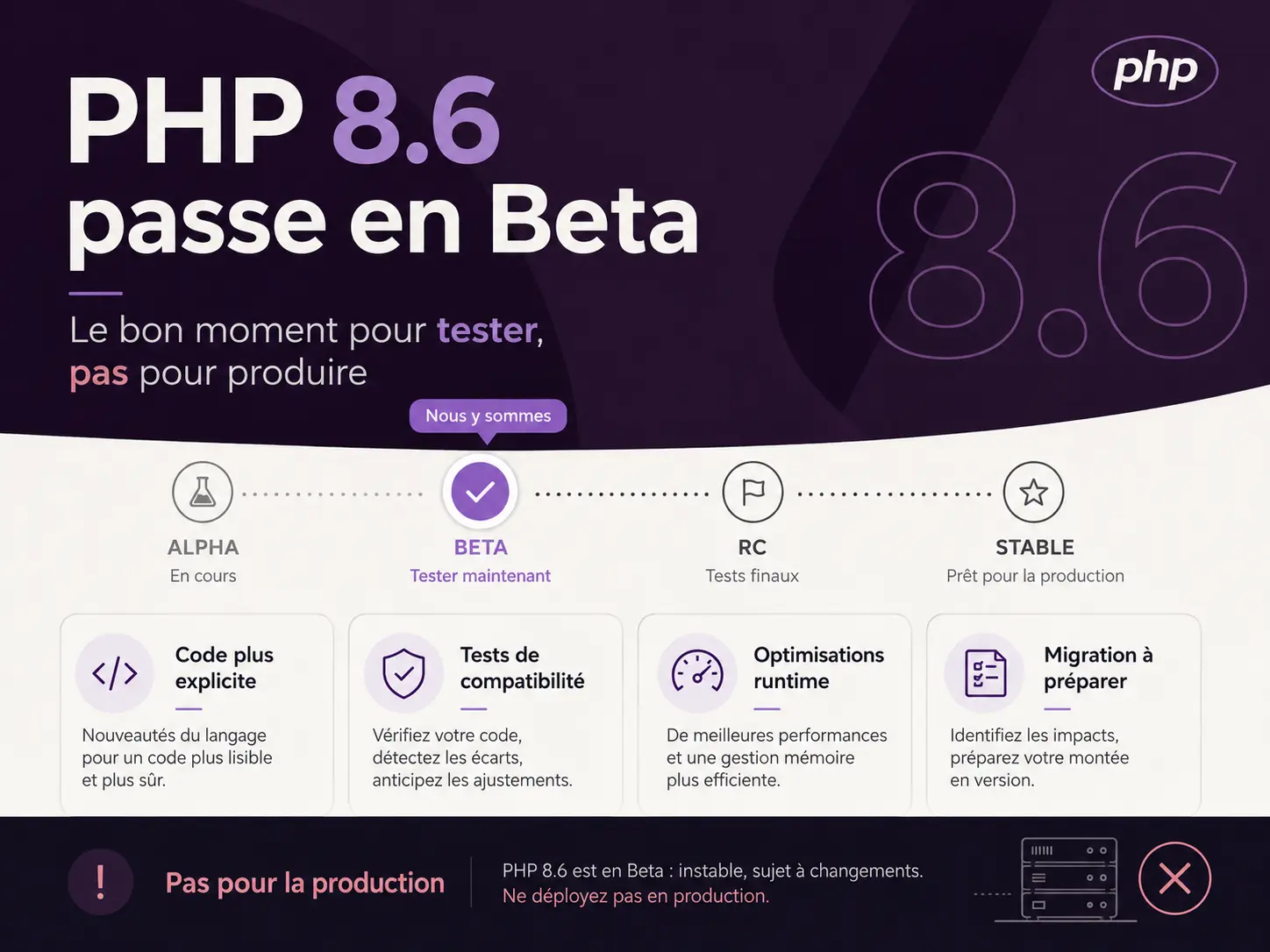
PHP 8.6 has just reached a significant milestone in its development: the first Beta is available.
RSS
RSS sends new articles to the reader of your choice, without an algorithm or newsletter.
This doesn’t mean you should open your production server and upgrade PHP this afternoon. A Beta remains a development version, with potential bugs, regressions, and an ecosystem that isn’t yet fully ready.
However, for developers, library maintainers, software publishers, or module editors, the signal is different: PHP 8.6 is starting to become concrete enough to warrant serious attention.
After three Alphas released over the summer, we’re gradually moving out of the period where the next PHP version mostly resembled a collection of RFCs.
The language is beginning to take its final shape.
What I find interesting about PHP 8.6 isn’t a spectacular feature meant to revolutionize everything.
It’s rather the accumulation of changes that all move in the same direction: making code more explicit, removing some long-standing irritants, and improving the runtime where the developer normally doesn’t have to do anything.
PHP 8.6 Truly Enters Its Testing Phase
The PHP 8.6 cycle began with Alpha 1 on July 2, 2026, followed by Alpha 2 on July 16 and Alpha 3 on July 30.
Beta 1 changes the nature of the work somewhat.
During the Alphas, features could still change significantly. As the Betas and then Release Candidates arrive, the scope stabilizes, and the goal becomes more about finding what breaks.
That’s exactly what this period is for.
If you’re developing a classic PHP application, you probably have no urgent reason to spend several hours on PHP 8.6 today.
However, if you maintain a library, framework, CMS, extension, or module used by hundreds of clients, waiting until November to discover a compatibility issue would be much less reasonable.
The stable release is currently scheduled for November 19, 2026.
This still leaves several months to test without rushing.
clamp(): Not Revolutionary, Just Much Clearer
Among PHP 8.6’s new features, clamp() nicely illustrates what I expect from a mature language today.
Imagine I want to ensure a percentage stays between 0 and 100.
Today, I can write:
$percentage = max(0, min(100, $percentage));
It works.
It’s not even particularly complicated.
But you still have to read the nesting of min() and max() to understand what the developer is trying to do.
With PHP 8.6:
$percentage = clamp($percentage, 0, 100);
The gain isn’t algorithmic.
The gain is in the intention.
Even someone joining the project several months later can immediately understand: this value must stay between 0 and 100.
We find the same benefit in pagination:
$page = clamp($page, 1, $maxPage);
An opacity:
$opacity = clamp($opacity, 0.0, 1.0);
Or any business data subject to minimum and maximum bounds.
This kind of function doesn’t enable something previously impossible.
And that’s precisely the point.
Not all useful language evolutions need to introduce a new way of programming. Some simply serve to better express what we were already doing.
On a single line, the difference seems tiny.
Multiplied across hundreds of thousands of lines of code, this pursuit of clarity starts to matter.
#[Override]: Letting PHP Verify What We Believe We’re Doing
PHP is also continuing to evolve the #[Override] attribute.
The idea behind this attribute is quite simple: when a developer states that an element overrides something from a parent or contract, PHP can verify that this is actually the case.
PHP 8.6 extends this logic to class constants.
For example, you can write:
interface PaymentProvider
{
    public const NAME = 'default';
}

final class StripeProvider implements PaymentProvider
{
    #[Override]
    public const NAME = 'stripe';
}
At first glance, one might consider the attribute as mere information for the person reading the code.
But its value is precisely that it’s not just documentation.
We’re giving additional information to the language.
We’re telling it:
This constant is supposed to override another one.
PHP can then verify this assumption.
If the parent contract evolves later and this override no longer makes sense, we have a better chance of detecting the problem immediately rather than several weeks later when encountering strange behavior.
This is an evolution I find healthy in PHP: making code express more intentions so the language can better protect us.
Static analyzers obviously already do a lot of work in this area. But when information can be part of the language itself, it becomes accessible to everyone, regardless of the project’s tooling configuration.
Some PHP 8.6 Improvements Won’t Change a Single Line of Your Code
There’s also a less visible part of the work done on PHP 8.6.
And this is often the part I find most interesting.
The engine continues to be optimized around closures and arrow functions.
PHP can notably better detect certain closures that don’t use $this and treat them as static when possible.
Other optimizations concern stateless closures.
Let’s take a deliberately simple example:
function callback()
{
    return static function () {
        return 'hello';
    };
}
If this function is called many times, PHP could theoretically create many objects representing a closure whose behavior never changes.
This isn’t very useful.
PHP 8.6 can now reuse some of these closures when conditions allow.
The developer doesn’t change anything.
They don’t add a magic annotation.
They don’t enable an option.
They don’t rewrite their architecture.
It’s the engine that does its job better.
Of course, this doesn’t mean all applications will suddenly become much faster with PHP 8.6. The gains depend heavily on the type of code executed.
Beware of benchmarks turned into slogans.
But this is exactly the kind of optimization I like to see in PHP: improving patterns already used by millions of developers without asking them to turn their code into an optimization lab.
Yes, Even trim() Changes
PHP 8.6 also slightly modifies the default behavior of trim(), ltrim(), and rtrim().
The Form Feed character, \f, will now be considered whitespace by default.
I doubt many developers were waiting for this feature this morning.
But this type of change also tells something about the evolution of a language approaching its thirtieth anniversary.
There are inevitably historical behaviors, inconsistencies, or choices made at a time when usage was different.
Evolving PHP isn’t just about adding features.
It’s also about gradually revisiting these details.
However, we must be careful about an important difference.
Adding clamp() doesn’t modify any existing behavior.
Modifying trim(), even slightly, can.
If an application intentionally depends on trim() preserving a \f character at the start or end of a string, its behavior will change in PHP 8.6.
This case is probably extremely rare.
But migrations rarely break because a developer didn’t understand the main feature displayed on the homepage of a new version.
They often break because of the small behavior change that no one had looked at.
This is also why Betas exist.
A Change to Watch on the MySQL and MariaDB Side
PHP 8.6 is also evolving certain constraints related to supported versions of its environment.
Among them, a change concerns persistent MySQL and MariaDB connections.
When a persistent connection is reused, it must be properly reset before being passed to another request.
Otherwise, a connection might potentially retain context elements from its previous use.
PHP 8.6 can use COM_RESET_CONNECTION to perform this reset.
For a modern infrastructure, this change shouldn’t generally cause any particular difficulty.
However, this also means that some very old versions of MySQL or MariaDB that don’t have this mechanism can no longer be used in exactly the same way for persistent connections.
This is typically the kind of point I would check on an old e-commerce application before a migration.
Not because PHP 8.6 suddenly creates a problem.
But because a PHP update is often an opportunity to discover that the real problem lies two layers down, on a component that no one has updated for several years.
Should You Test PHP 8.6 Now?
For a production site: no.
For a development or CI environment: it’s starting to make sense.
The distinction is important.
A Beta isn’t a “nearly stable version you can use if you’re careful.”
It’s a version released precisely to be tested before stability.
If you maintain a PHP project, you can, for example, simply start by running your test suite on PHP 8.6.
You might discover it passes immediately.
Great.
You might discover a deprecation or a behavior change.
Even better: that’s exactly the information we’re looking for today.
You might also discover it’s not your code that’s blocking, but a dependency.
And you’ll then know several months before the stable release that you’ll need to watch for its update.
This is much more comfortable than discovering the problem when the infrastructure needs to migrate.
What PHP 8.6 Mostly Tells Us About PHP Today
At this stage, I don’t see PHP 8.6 as a version that will revolutionize how we develop.
And I don’t necessarily expect one.
PHP is now a mature language.
It has types, enums, attributes, typed properties, readonly properties, a solid exception system, very advanced static analysis tools, and an ecosystem that has changed enormously since PHP in the 2000s.
The question is no longer about reinventing the language every year.
It’s rather about continuing to reduce its inconsistencies.
clamp() allows expressing an intention more directly.
#[Override] allows the language to verify more of what the developer asserts.
Some closures can be better optimized without any modification to the application code.
Historical behaviors like those of trim() continue to be cleaned up.
And some communication components with external systems, like MySQL, are modernized.
Taken separately, none of these changes is spectacular.
Taken together, they nevertheless draw a fairly clear direction.
PHP is less about giving us new ways to program than about making existing ways cleaner, more predictable, and easier to maintain.
And for a language used for decades on sometimes gigantic codebases, this is probably much more useful than a new spectacular syntax every six months.
PHP 8.6 is still in Beta.
I obviously won’t install it tomorrow on a production store.
However, I will start running some projects on it.
Because the best time to discover that an application doesn’t work on PHP 8.6 isn’t November 19.
It’s now.
Sources
This article is based on the official PHP 8.6 development schedule as well as PHP RFCs and proposals related to clamp(), the extension of #[Override] to class constants, closure optimizations, the evolution of trim(), and changes to minimum supported versions.
