TL;DR
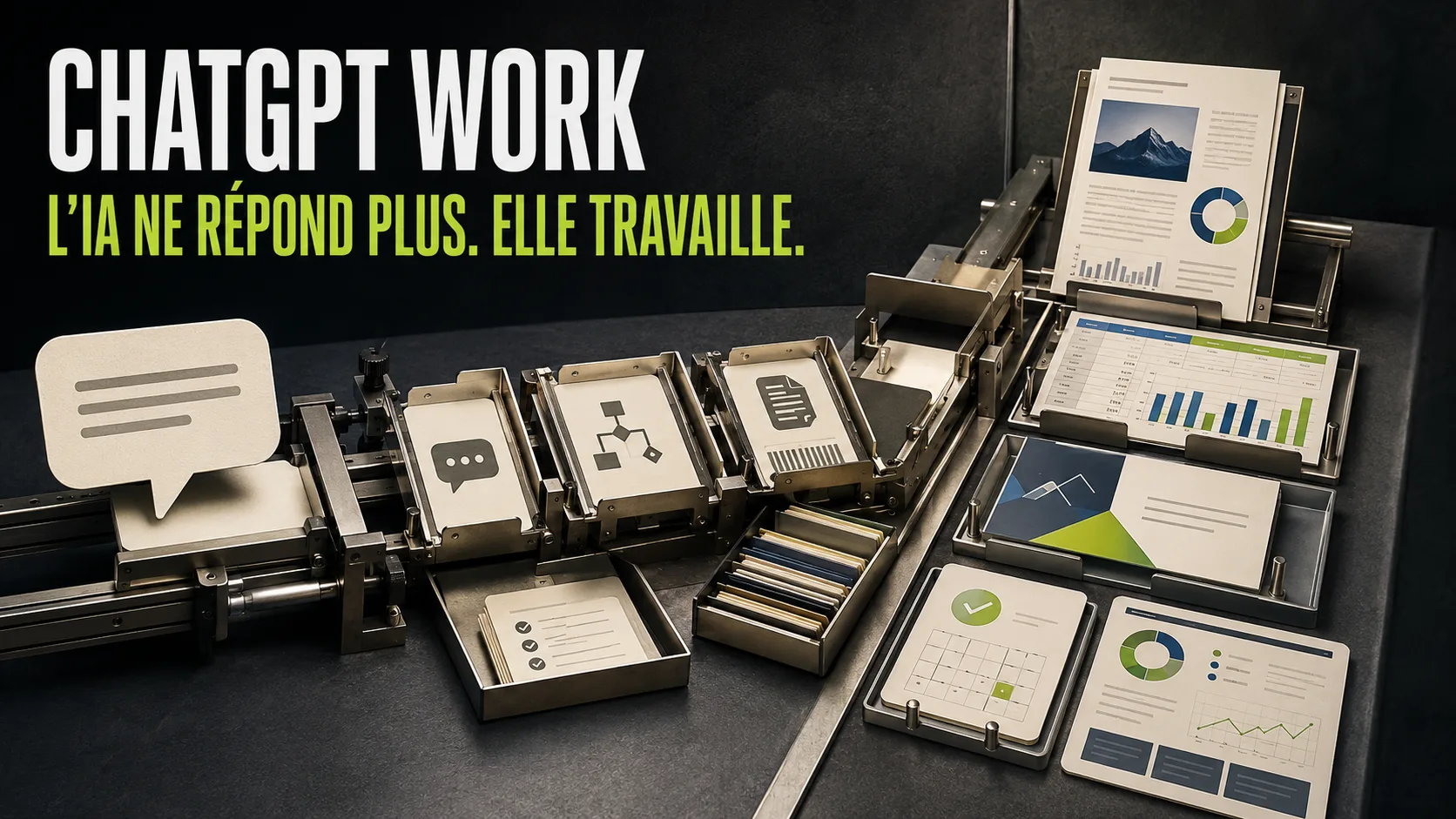
- ChatGPT Work is no longer limited to answering: it researches, plans, acts, and produces finalized deliverables.
- The real change doesn’t come solely from GPT-5.6, but from the connection between the model, files, applications, plugins, and scheduled tasks.
- OpenAI now clearly separates three uses: Chat for conversing, Work for producing, and Codex for developing.
- The more autonomous the agent becomes, the more permissions, traceability, and human validation become important.
For a long time, using ChatGPT meant asking it a question and getting an answer.
A good answer, sometimes excellent.
But always just an answer.
With ChatGPT Work, OpenAI is trying to move this boundary. The product introduced on July 9, 2026, no longer just wants to participate in a conversation. It aims to take charge of an objective, gather the necessary context, work across multiple tools, and turn it all into a usable result.
The change may seem subtle.
It is not.
The problem was no longer really about generating text. The models could already do that. The problem was everything surrounding it: finding the right information, understanding its context, switching between applications, maintaining a project over time, and producing a truly usable deliverable.
ChatGPT Work is precisely trying to become this orchestration layer.
🧠 This is not a new conversation mode
OpenAI presents ChatGPT Work as an agent capable of staying on a project for several hours, breaking down an objective into steps, and producing documents, spreadsheets, presentations, reports, or web applications.
In other words, we no longer just ask it:
“What do you think of this data?”
We can ask it:
“Analyze this data, compare it with last month’s results, identify discrepancies, prepare the summary table, and turn the conclusions into a presentation for management.”
The difference is not in the length of the prompt.
It’s in the responsibility entrusted to the system.
OpenAI also clarifies the separation between its three main experiences in its ChatGPT Work and Codex documentation:
| Experience | Primary Use | Expected Outcome |
|---|---|---|
| Chat | Question, quick search, reflection, or conversation | An answer |
| Work | Long research, analysis, and creation of deliverables | A finalized work product |
| Codex | Development, testing, commands, and work on a repository | A verified software modification |
This separation is important.
Not all requests require an autonomous agent. Asking a simple question in Work would be as relevant as launching a multi-agent architecture to correct a typo.
Chat remains the space for quick exchanges. Codex retains software work. Work takes the area in between: long, documentary, cross-functional tasks that are often difficult to contain within a single application.
🔌 The real product is the connected context
A powerful model without context remains an excellent generator of generalities.
This is probably the most important point about ChatGPT Work.
The product can retrieve information from the tools where work already exists: messaging, emails, calendars, document spaces, CRMs, project management tools, or local files on the desktop application. OpenAI also announces over 1,400 plugins capable of providing skills, application connections, and workflow templates.
The model is therefore no longer isolated in a conversation window.
Depending on the connections and permissions granted, it can find a decision in Slack, consult a document in Google Drive, analyze data, and then produce a support adapted to the project’s context.
This is where ChatGPT Work can truly save time.
Not by writing a sentence faster than a human.
But by eliminating some of the invisible work that precedes that sentence: searching, opening, copying, cross-referencing, reformatting, and verifying that you’re working with the latest version.
In many companies, the knowledge already exists. It’s simply scattered across ten tools and twenty conversations.
ChatGPT Work doesn’t automatically create a perfect corporate memory. It offers a layer capable of mobilizing this knowledge when a task needs it.
This nuance is essential.
Connecting tools isn’t enough to structure information. An outdated document remains outdated. A contradictory decision remains contradictory. Overly broad permissions remain dangerous.
The agent can better leverage context.
It doesn’t relieve the company of governing it.
📄 The output is no longer text, but a deliverable
The promise of ChatGPT Work doesn’t stop at synthesizing information.
The system can create or modify documents, spreadsheets, presentations, reports, and analyses. It can also use a reference file, adhere to an existing template, and preserve important elements like formulas, structure, tone, or visual identity.
The official documentation on file creation clearly shows the shift in logic: you must describe the deliverable’s use, provide sources, specify the output format, and indicate what must remain unchanged.
You’re no longer just writing a prompt.
You’re defining a performance contract.
This way of working closely resembles what developers already know with code agents: giving an objective isn’t enough. You also need to provide context, constraints, validation criteria, and a definition of what “done” means.
ChatGPT Work generalizes this approach to finance, marketing, sales, operations, or data analysis professions.
However, the result must remain verifiable.
A well-presented table can contain a bad formula. A convincing presentation can rely on an outdated source. A perfectly structured report can hide a fragile assumption.
A finalized deliverable doesn’t mean human validation disappears.
It means humans can shift their attention from creation to verification and decision-making.
⏱️ Scheduled tasks transform the assistant into a process
Creating a report once is useful.
Maintaining it automatically is much more interesting.
With Scheduled Tasks, ChatGPT Work can execute a one-time action, repeat a task on a schedule, react to an event, or monitor changes. It then becomes possible to ask the system to track new customer feedback, update an agenda based on the week’s exchanges, or generate a report when data changes.
This is where we truly leave the chatbot behind.
A conversation waits for a prompt.
A process continues to exist between prompts.
For an e-commerce team, you could imagine recurring incident tracking, a weekly support feedback summary, or updating a risk table based on connected tools.
But automating a bad process doesn’t make it better.
Before scheduling a task, you still need to define its frequency, sources, stop conditions, recipients, authorized actions, and cases requiring human validation.
Without this, you don’t gain an autonomous assistant.
You gain a recurring error.
🛡️ More autonomy means more governance
The presentation page emphasizes ChatGPT Work’s ability to act within a company’s tools. This is obviously what makes the product interesting.
It’s also what increases its risk level.
An agent capable of reading a file, modifying a spreadsheet, consulting a CRM, or triggering an action should not have more rights than the task requires.
OpenAI indicates that Enterprise and Edu administrators can control authorized users, accessible context, available connections, and permitted actions. The browser, network access, plugins, and certain sensitive operations can also be restricted. A self-review mechanism should examine important actions before execution.
These protections are necessary.
They don’t replace a clear internal policy.
The right question isn’t:
“Can ChatGPT Work access our CRM?”
The real question becomes:
“Which data should it access, for which task, for how long, and with what revocation possibilities?”
A serious agent-based architecture always relies on the same principles: minimal permissions, traceable actions, isolated secrets, risk-proportionate validation, and the ability to interrupt the workflow.
ChatGPT Work makes agent-based systems accessible to more professions.
It therefore also makes its governance essential for more teams.
⚠️ A powerful launch, but still fragmented
We must finally distinguish the product’s vision from its state at launch.
As of July 10, 2026, ChatGPT Work is being rolled out according to plans and platforms. The web and mobile experience works in the cloud, while the desktop application can access local files and applications with user permission.
Continuity isn’t yet complete: Work conversations created in the cloud don’t initially appear in Work on desktop, and local projects remain on the relevant machine. The web and mobile versions can’t directly access computer files.
File creation also depends on format, plan, and workspace settings. Google Docs, Sheets, and Slides are supported when the corresponding applications are connected. Excel can be controlled via its add-in, but PowerPoint isn’t integrated into the desktop Work flow at launch.
These aren’t details.
They determine where context is located, where deliverables are saved, and what a workflow can truly automate.
It’s therefore best to avoid designing critical processes now by assuming all surfaces, files, and conversations are perfectly synchronized.
The direction is clear.
The experience is still under construction.
🚀 What ChatGPT Work really changes for businesses
The main change isn’t that every employee will be able to generate more content.
That would be a very limited view of the product.
The challenge is to transform certain repetitive and cross-functional tasks into explicit workflows capable of gathering context, producing a result, and maintaining that result over time.
This forces companies to better define their own operations.
Which sources are authoritative? Who owns the decision? Which template must be followed? What can the agent modify? What evidence must accompany the result? At what point should a human take over?
These are organizational questions before being artificial intelligence questions.
The teams that will get the most value from ChatGPT Work probably won’t be those that write the most impressive prompts.
They’ll be those that know how to turn their know-how into usable context, controlled permissions, validation criteria, and observable processes.
Conclusion
ChatGPT Work isn’t just ChatGPT with an extra button.
It’s the materialization of a deeper change: AI no longer just wants to participate in work. It wants to execute part of it.
The model answered.
The agent produces.
The work system, however, gathers the context, tools, files, automations, and controls needed to reach the result.
This evolution can truly increase teams’ capacity. But it won’t eliminate the need for framing, responsibility, or human validation.
On the contrary.
The more capable AI becomes of acting, the more precisely the company must know where it can act, with what rights, and according to which rules.
The next competitive advantage won’t come from the number of tasks entrusted to ChatGPT Work.
It will come from the quality of the systems built around those tasks.