


Introduction
We live in a time when access to information has never been easier. In just a few seconds, it’s possible to find an analysis, a video, a podcast, or a summary on almost any topic. Yet, this abundance creates a new challenge: it’s no longer information that’s lacking, but our ability to understand it, sort through it, and give it meaning.
Current technological transformations, particularly around artificial intelligence, are profoundly changing our relationship with knowledge. Tools are becoming increasingly powerful and accessible, but the real value is gradually shifting toward the ability to analyze, question, and participate in the decisions that will shape our future.
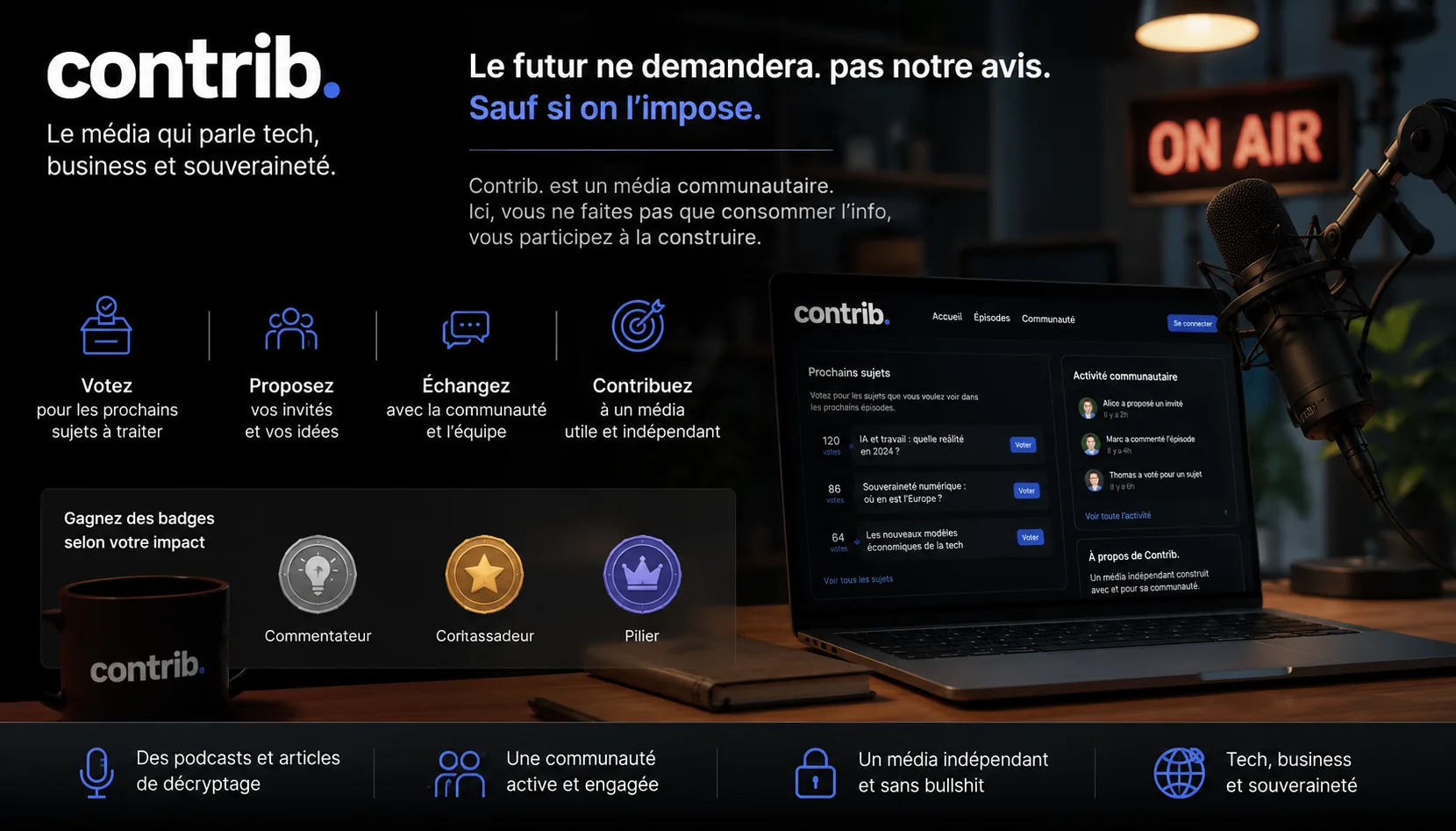
It’s in this context that the Contrib. initiative is interesting. The project doesn’t position itself solely as a podcast or a media outlet covering tech, business, and digital sovereignty. It seeks to experiment with a different relationship between those who produce information and those who consume it.
From Audience to Community
For a long time, the traditional media model relied on a fairly simple relationship: people produced content, and an audience came to consume it. This model enabled the creation of many benchmarks, but the digital world has deeply changed expectations.
Today, a community no longer just wants to receive information. It wants to understand, exchange, challenge ideas, and sometimes participate directly in shaping the topics. The value is no longer found solely in the published content but also in the interactions it sparks.
This is precisely what makes Contrib.’s approach so interesting. The project’s name itself carries an intention: to put contribution at the center. The idea isn’t just to create a media outlet that talks about transformations but a space where those involved can participate in the reflection.
This approach echoes certain principles found in the open-source world. A project doesn’t progress solely thanks to its initial creators but through all the people who use it, test it, propose improvements, and enrich the ecosystem.
Technology Advances, but Understanding Remains Essential
Artificial intelligence perfectly illustrates this evolution. Models are now capable of producing text, images, code, or analyses at an impressive speed. But having a powerful tool doesn’t automatically mean knowing what to do with it.
The central question is no longer just: "What technology is coming?" It has become: "How will we intelligently integrate it into our professions, businesses, and society?"
Specialized media thus have an evolving role. Their mission can no longer be limited to reporting on new developments. They must help us understand the implications, provide context, and enable people to step back from rapid changes.
This is also why topics around digital sovereignty are becoming important. Sovereignty isn’t just about infrastructure or data. It’s also about our collective ability to understand the tools we use and to avoid letting only a few actors decide the direction we take.
Building the Reflection Spaces of the Future
The next generation of media will likely be defined less by the quantity of content produced than by the quality of the communities built around that content.
In a world where artificial intelligence will be able to generate ever more information, what will become rare is high-quality human exchange: discussions, shared experiences, constructive disagreements, and the ability to develop a common vision.
Initiatives like Contrib. are exploring this direction by trying to bring media closer to its community. Content becomes a starting point, not an end in itself. Discussion becomes an integral part of the value created.
This is an interesting evolution because major technological transformations won’t be defined solely by the tools we use. They’ll also be defined by the spaces we build to discuss them and the collective decisions we make.
Conclusion
We cannot stop the transformations that are coming. Artificial intelligence, new technologies, and new economic models will continue to evolve.
However, we can choose our stance in the face of these changes. We can be mere spectators, or we can actively participate in shaping the future.
The approach taken by Contrib. offers an interesting perspective: in a world where information is becoming abundant, contribution may become a new form of value.
Understanding the future isn’t just about observing it.
It’s also about taking part in building it.