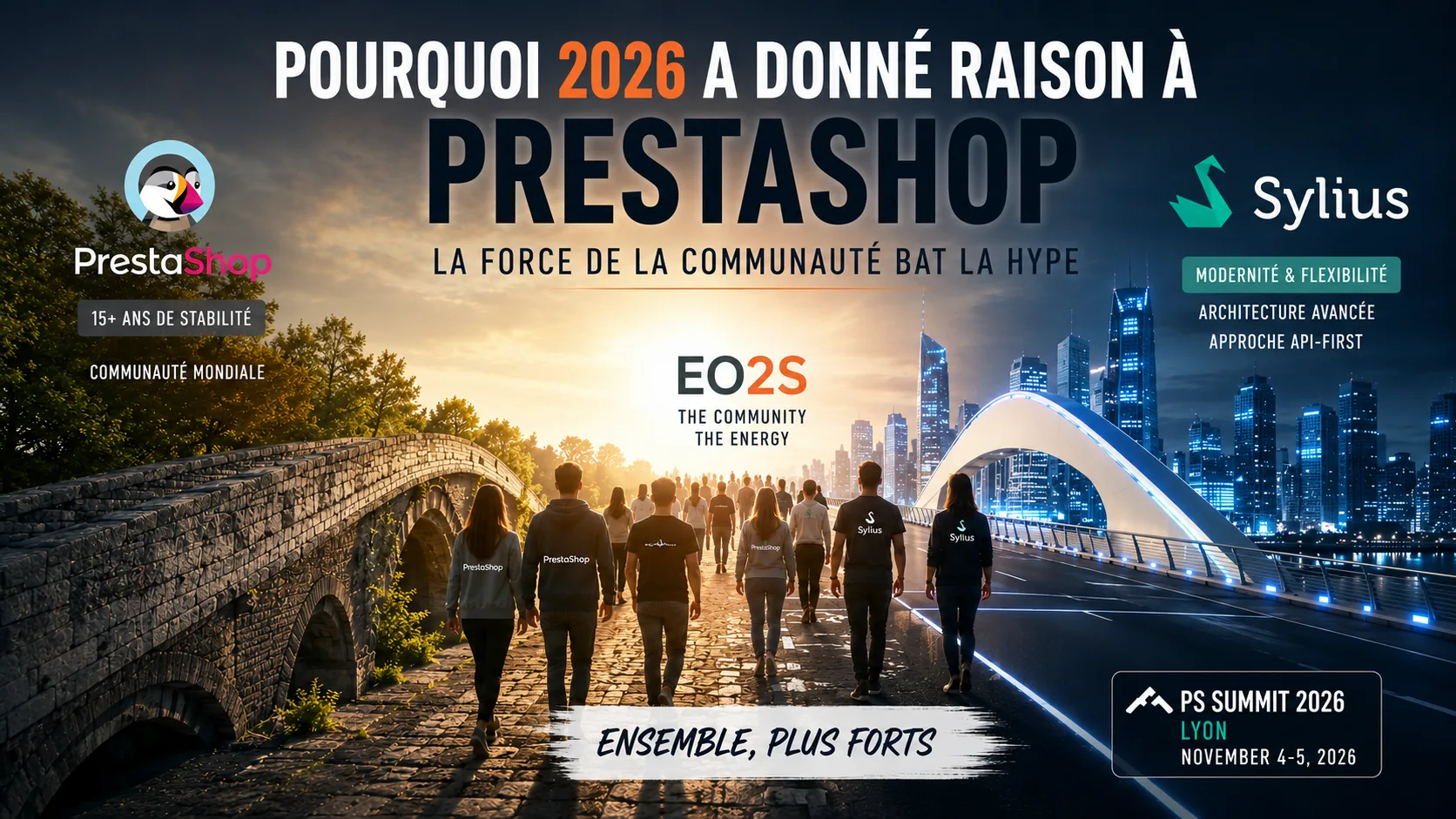
One year after writing "PrestaShop vs Hype," the facts are more compelling than any opinions.
In 2025, I defended a simple idea: stability is often underestimated in the software industry.
In 2026, this idea is no longer just an opinion.
PrestaShop's acquisition by cyber_Folks, the strategic partnership with Sylius, the energy seen at EO2S, and the launch of the PS Summit reveal a reality that many market players tend to overlook:
The value of a platform is not measured solely by its architecture or perceived modernity.
It is measured by its ability to endure, evolve, and unite a community.
And in this regard, PrestaShop is probably stronger today than it has ever been.
🔄 Revisiting a 2025 Prediction
At the end of 2025, I published an article titled:
"PrestaShop vs Hype: Why Stability Beats Modernity"
At the time, the debate kept resurfacing.
On one side, platforms considered "modern."
On the other, PrestaShop, often portrayed as a historical player, sometimes even labeled as legacy by those who only scratched the surface.
My argument was simple:
The software industry regularly overestimates novelty and underestimates durability.
A platform that has existed for fifteen years is not necessarily outdated.
It has simply survived fifteen years of technological changes, economic crises, market shifts, and evolving user expectations.
This survival is not an accident.
It is proof.
One year later, events seem to have confirmed this intuition.
🤝 The False Debate Between PrestaShop and Sylius
For a long time, part of the ecosystem presented PrestaShop and Sylius as opposing visions.
PrestaShop represented accessibility, ecosystem, merchant volume, and maturity.
Sylius embodied flexibility, an API-first approach, modern architecture, and complex projects.
This opposition was always reductive.
Because it assumed you had to pick a side.
Yet the market sent a very different message.
The partnership between PrestaShop and Sylius shows that these two platforms are not enemies.
They address different needs while sharing common foundations: open source, Symfony, a strong technical culture, and a commitment to long-term building.
The question is no longer:
Which platform will replace the other?
The question becomes:
How can two complementary ecosystems create more value together?
This is a far more interesting evolution.
And probably much more mature.
🌍 What EO2S Really Demonstrated
When discussing a community event, it’s easy to focus on the conferences, announcements, or numbers.
For me, the most important aspect was elsewhere.
EO2S reminded us of something that comparison charts systematically overlook:
A platform is not its code.
A platform is a community.
Behind every store are developers, integrators, agencies, module publishers, freelancers, hosting providers, contributors, and merchants.
It is this collective that creates value.
Not just the GitHub repository.
Not just the features.
Not just the technology.
The PrestaShop ecosystem has sometimes been criticized.
But when you physically bring its players together, you quickly realize the scale of the network built over nearly two decades.
And this is precisely the kind of asset that cannot be bought.
A community is built year after year.
Contribution after contribution.
Project after project.
Trust after trust.
🏛️ The Real Asset: Longevity
In the startup world, novelty is often seen as a virtue.
In commerce, it’s often the opposite.
A merchant doesn’t look for the trendiest platform.
They look for one that will still be there tomorrow.
Then in five years.
Then in ten years.
This difference is fundamental.
E-commerce is a business of continuity.
Switching platforms is costly.
Training teams is costly.
Migrating data is costly.
Rebuilding processes is costly.
Companies naturally seek platforms capable of standing the test of time.
And this is where the Lindy effect becomes interesting.
The longer a technology survives, the higher its probability of continuing to exist.
PrestaShop is no longer a promise.
PrestaShop is proof.
🤖 The AI Paradox
One of the surprises of recent years concerns artificial intelligence.
Many assumed AI would favor the newest platforms.
In practice, the opposite is often observed.
AI agents excel when they have rich context.
They need:
documentation,
examples,
history,
discussions,
feedback,
existing code,
accumulated best practices.
In other words, they perform particularly well in ecosystems that have already built significant collective memory.
This is precisely what PrestaShop and Sylius possess.
Years of documentation.
Thousands of projects.
Thousands of developers.
Millions of lines of usable context.
AI does not replace this legacy.
It amplifies it.
🚀 The Signal Sent by the PS Summit
The announcement of the PS Summit powered by PrestaShop & Sylius is probably more significant than it appears.
Because it tells a story.
For years, the industry sought to pit platforms against each other.
Open source vs. SaaS.
Monolithic vs. headless.
Legacy vs. modern.
PrestaShop vs. Sylius.
Today, the market seems to favor a different logic.
Cooperation over opposition.
Complementarity over replacement.
Building over destruction.
This approach is less spectacular.
But it is often more effective.
🎯 The Real Lesson of 2026
I don’t think 2026 proved that PrestaShop is perfect.
No platform is.
I also don’t think modernity is useless.
It remains essential.
Architectures evolve.
Uses evolve.
Expectations evolve.
But 2026 reminded us of something important.
Technology alone does not create sustainability.
What creates sustainability is the balance between innovation and stability.
Between vision and execution.
Between evolution and continuity.
While the industry chased the next revolution, PrestaShop continued to do what it has done for years:
evolve gradually,
modernize its foundation,
strengthen its ecosystem,
and unite its community.
Today, with Sylius by its side, this balance seems stronger than ever.
Conclusion
In 2025, I wrote that stability often beats modernity.
In 2026, I would say something slightly different.
Stability alone is not enough.
Modernity alone is not enough either.
The platforms that win are those that manage to evolve without losing what made them strong.
The partnership between PrestaShop and Sylius, the vitality seen at EO2S, and the momentum of the PS Summit tell exactly this story.
A story less spectacular than trends.
But much harder to replicate.
And in software as in e-commerce, it’s often the stories that last that ultimately win.
Nicolas Dabène
PrestaShop developer, open-source e-commerce observer, and passionate about systems that outlast hype cycles.