
Contents
RSS
RSS sends new articles to the reader of your choice, without an algorithm or newsletter.
1. Introduction: Moving Beyond the "Fuzzy Prompt" in Development
In today's software engineering ecosystem, productivity no longer depends solely on mastering syntax but on the ability to transform a vague intention into an actionable technical instruction. The major challenge developers face isn’t what they ask AI, but the imprecision of the request.
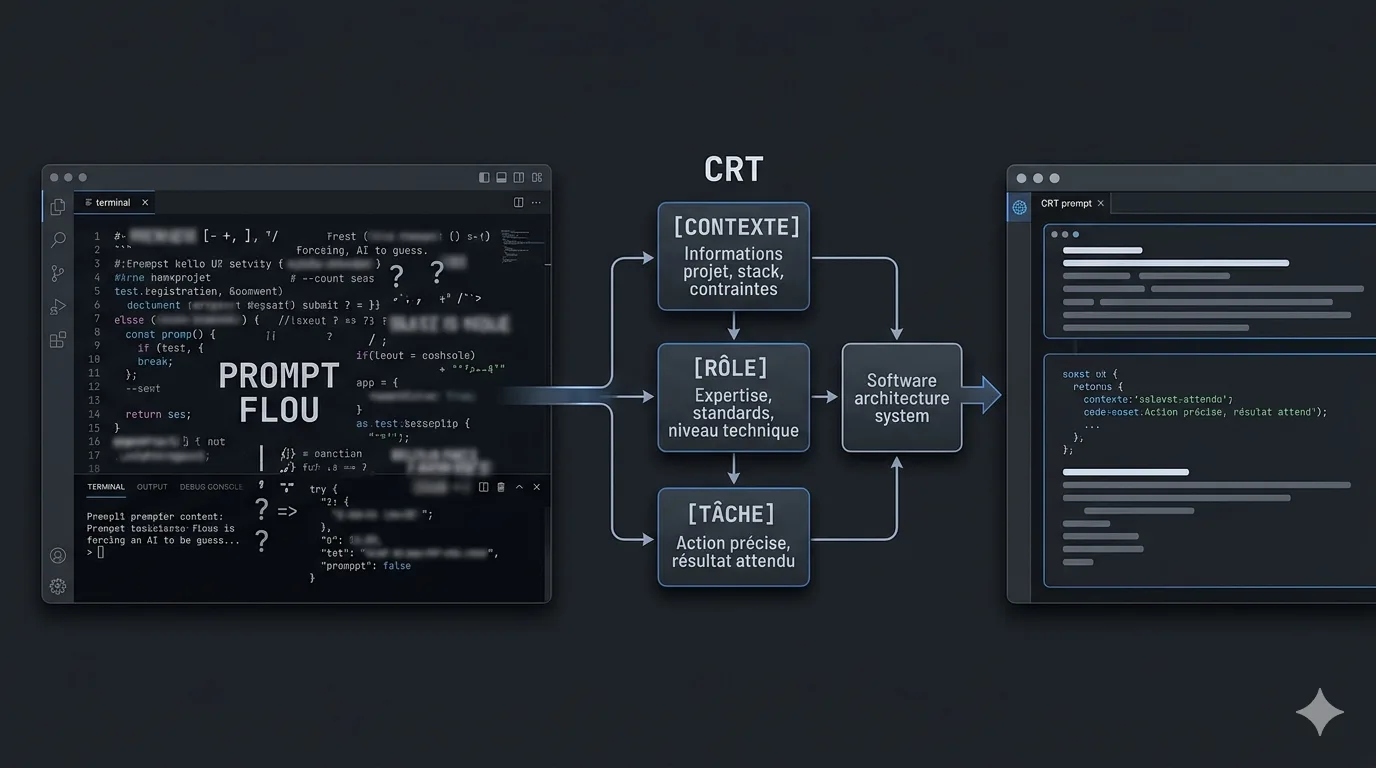
When a developer submits a "Fuzzy Prompt," the AI instantly becomes a guessing machine. It must fill in the user’s gaps by improvising on technical level, coding standards, or architectural constraints. For developers, this "guesswork" translates into costly operational friction: off-topic code, immediate technical debt, or dangerous hallucinations in business logic. The CRT method (Context, Role, Task) acts as a "mini-request architecture," structuring the exchange to shift from a mere text generator to a true engineering partner.
2. Anatomy of the CRT Method: Context, Role, Task
The CRT method is a minimal framework designed to eliminate ambiguity. In prompt engineering, the goal isn’t to write novels but to clarify critical variables so the AI stops interpreting and starts executing.
Breakdown of the Three Pillars
- Context: Defines the request’s environment. Who is the target audience? What is the tech stack? What is the overall goal? Context fuels the response by providing the necessary data for reasoning.
- Role: The identity adopted by the AI calibrates tone, precision level, and standards. Requesting an expert role avoids outdated solutions (e.g., PHP 5.6 instead of 8.2) and ensures professional rigor.
- Task: The precise action. Pro tip: The "next-level" approach is to not ask for the final code immediately but to first demand a plan, structure, or clarification questions.
Summary: Fuzzy Prompt vs. CRT Prompt
| Aspect | Fuzzy Prompt (Guessing Machine) | CRT Prompt (Engineered Request) |
|---|---|---|
| Example | "Help me with an API." | C: Beginner video on digital culture. R: Technical popularization expert. T: First propose a structured script outline. |
| Effect | AI improvises level and format. | AI produces a result aligned with the goal. |
| Risk | Hallucinations and mismatched code. | Surgical precision and time savings. |
This structure is the bulwark against unusable results that clutter the development cycle.
3. Practical Case 1: Developing a Prestashop Module
Working with a CMS like Prestashop requires strict contextual rigor to avoid code incompatible with modern versions (Prestashop 8.x).
CRT Application
Prompt:
- Context: Creating a promotions management module for Prestashop 8.1, targeting B2B merchants.
- Role: Senior Prestashop Expert adhering to PSR-12 standards and the CMS’s Symfony structure.
- Task: First propose the list of required hooks (e.g.,
actionCartSave) and the file tree before generating any code.
Analysis: By forcing the AI to validate the technical structure and hooks before implementation, we prevent it from generating obsolete monolithic code. The Senior Expert role ensures the use of namespaces and modern service containers instead of legacy static classes.
4. Practical Case 2: Laravel Architecture and Logic
In modern frameworks, AI excels at structuring business logic—if guided on architectural patterns.
CRT Application
Prompt:
- Context: Payment microservice in a Laravel 11 application following hexagonal architecture principles.
- Role: Software Architect specializing in Clean Code.
- Task: Sketch the interface contract and
PaymentServiceclass structure with dependency injection. Ask me 3 clarification questions about payment gateways (Stripe/Adyen) before proceeding.
Justification: Here, the Task prioritizes design. Requesting an "interface contract" enforces decoupling rigor that the AI would overlook in a fuzzy prompt. This prevents spaghetti code and reduces technical debt from the outset.
5. Practical Case 3: Brainstorming a New Feature
AI isn’t just an executor—it’s a co-creation partner. Using CRT in brainstorming turns the tool into a strategic consultant.
CRT Application
Prompt:
- Context: Gamification feature for a B2B productivity SaaS. Goal: Increase monthly retention.
- Role: Product Designer specializing in engagement psychology (Gamification).
- Task: Don’t propose solutions yet. Ask me 5 critical questions to identify my technical constraints and the user behaviors I want to encourage.
The Collaborative Approach: This method flips the burden of proof. Instead of expecting a perfect answer on the first try, we use AI to spotlight the project’s blind spots, refining the initial intent before production.
6. The Collaborative Approach: Using AI to Refine the Prompt
Shifting from a "command prompt" to a "conversational prompt" is the real paradigm shift. The first prompt should often just initiate a clarification phase.
Collaborative Optimization Strategies
- Mirror Prompt: "Here’s my technical intent [Intent]. Identify the fuzzy areas you’d have to guess to respond, and ask me questions."
- Triangulation: "Propose a simple, precise, and advanced version of this prompt for my needs."
- Self-Improvement: "Act as a Prompt Engineering expert. Rephrase my initial request to maximize generated code quality per SOLID standards."
Beyond the Prompt: Context Engineering If Prompt Engineering structures the request, final quality also depends on the data provided. The "next level" is Context Engineering: feeding the AI your own documentation, config files, or style guides so it stops guessing and reasons within your actual environment.
7. Practical Tool: Universal CRT Prompt Template
Use this template to standardize exchanges and automate clarity in your daily workflow.
# CONTEXT
[Project, tech stack, version, target audience, overall goal]

# ROLE
[Expert/Architect/Educator – Defines standards and tone]

# TASK
[Precise action. Request structure/questions before the final output]

# CONSTRAINTS & FORMAT
[Output format (JSON, Markdown, Code), what to avoid, PSR standards, etc.]
Golden Rules for Execution:
- Precision beats length: Don’t write a novel—clarify friction points.
- Humans are sovereign: AI proposes and rephrases; the developer validates and directs. Human validation remains the only safeguard against business logic errors.
- Iterate systematically: The best prompt is rarely the first; it’s the product of mutual clarification.
AI performance isn’t about "magic"—it’s a direct reflection of your instructions’ intelligence. By structuring requests with the CRT method, you stop enduring the machine’s guesswork and start piloting a robust, predictable work assistant.
