
🎁 Perplexity PRO offert
AI, Pig Butchering, and the New Frontier of Scams: Why Scammers Are Becoming Developers
Introduction: When AI Orchestration Becomes a Weapon
Imagine a scenario that seemed impossible just two years ago: a scammer calls you with your mother’s exact voice, begging for urgent help, and you’re ready to send $5,000. Or even better: a person you meet on a dating app, with a perfect smile, a dream life, who for three months advises you to invest in a crypto opportunity. Except it’s a deepfake.
This is no longer science fiction. This is 2025.
The AI technologies that fascinate us — sophisticated LLMs, voice synthesis models, diffusion models for videos — are transforming one of the oldest forms of fraud: pig butchering. The result? A technical and psychological combination that makes these scams exponentially more effective.
What you’ll discover in this article: how AI multiplies the vectors of pig butchering, why scammers are becoming AI orchestrators, and most importantly — how as an entrepreneur, developer, or creator, you must rethink your vigilance against a threat that no longer only exploits humans, but our capacity to believe the impossible.
Part 1 – Context & Stakes: Traditional Scam Meets AI
Pig Butchering: An Ancient Scam
Pig butchering is not new. The concept goes back decades: a scammer establishes a prolonged relationship of trust with a victim (weeks, months), then encourages them to invest in a fraudulent opportunity before disappearing with the funds. The term itself comes from Chinese sha zhu pan (杀猪盘), which literally reflects the process: you “fatten the pig” with trust before “bleeding” it.
Key figures 2024-2025:
- $1.3 billion lost in romance scams in 2024-2025 (FTC)
- 40% of users of dating apps have been targeted by a scam
- 8 million deepfakes expected to be shared in 2025
- 77% of victims of cloned voice scams lost money
Until now, these scams depended on a rare resource: human time. A scammer could manage 5, maybe 10 victims in parallel. The operation was slow, manual, artisanal.
The Arrival of AI: The Scalability of Lies
Now, here’s the tension: the same tools that allow developers to create useful chatbots, generate marketing content, or automate workflows can be used to scale pig butchering to an industrial and frightening scale.
Three paradigm shifts:
-
LLMs manage thousands of conversations in parallel — A scammer no longer needs to manually write messages. State-of-the-art language models can generate personalized content, adapt tone, handle multiple languages, and maintain narrative consistency over months. The tools exist, some are free, others cost a few dollars per month.
-
Voice synthesis and deepfakes make “proof” indisputable — A few seconds of audio recording of a person, and a scammer can create an almost perfect voice clone. Deepfake videos can show a fake investor “for real,” supporting pig butchering promises. 70% of people cannot distinguish a cloned voice from the original.
-
Automation of fraudulent workflows — With tools like n8n, Make, or API integrations, scammers can automate the complete cycle: target detection, first contact, progressive escalation, wallet data extraction, cryptocurrency conversion, money laundering.
The result: The marginal cost of an additional scam becomes almost zero. A single scammer, armed with AI, can target 10,000 people instead of 10.
Part 2 – Decryption / Analysis: How AI Turbocharges the Fraud Machine
2.1 LLMs as Orchestrators of Lies at Scale
LLMs don’t judge. They generate what they’re asked to. A scammer using GPT-5, Claude, or any model can ask:
"Generate 100 flirty and personalized messages adapted to profiles of
singles between 40-55 years old, with credible autobiographical elements
of a crypto businessman. Vary the tone, cultural references,
and ensure progressive progression towards mentioning lucrative investments."
Result? 100 perfectly targeted first contacts, each resembling an authentic human message, in less than a minute. No trace of a bot. No sign of automation.
The scale of the problem:
- Scammers can manage 3 to 5 times more victims thanks to AI
- Messages are individualized — response rate is higher than with classic spam
- Narrative consistency is maintained over time — no forgetting, no inconsistencies that betray the bot
2.2 Video Deepfakes: The Death of Visual Trust
One of the last defenses against pig butchering was simple: “Ask for a video call.” If the person refused, it was a warning signal.
This no longer works.
In real-time, with tools like Synthesia, D-ID, or even open-source models like LivePortrait, a scammer can now:
- Use a stolen photo of an attractive person
- Generate a video where they speak, with facial expressions matching your live conversation
- Give you a “proof of life” video call practically indistinguishable from the real thing
Tests show that even experts struggle to detect these high-quality video deepfakes in real-time.
Psychological impact: For a victim, this is the extinction of a last doubt. If you’ve seen the person on video, spoken with them (or thought you spoke with them), you are psychologically “locked” into trust.
2.3 Voice Synthesis: The Silent Weapon of Pig Butchering
Voice cloning is even more accessible than video deepfakes. With free tools available online:
- A 10-30 second recording is enough
- In 5 minutes, a voice clone is generated
- 77% of victims who received a call from a voice clone lost money
Typical scenario:
- The scammer collects a voice recording of a targeted person (public interview, YouTube video, recorded call)
- They generate a convincing voice clone
- They call a relative pretending to be the victim: “I had an accident, I need $5,000 now”
- The person hears a voice identical to their friend’s. They transfer the funds.
Why it’s effective in pig butchering:
- The scammer can now call victims with an “authority” or “friend” voice
- Calls are more convincing than text messages
- The emotional factor (urgency, panic tone) is amplified
2.4 Automation of Fraudulent Workflows
For a developer with knowledge of n8n or Make, orchestrating a pig butchering operation becomes almost trivial:
Possible automated workflow:
- Target sourcing: Scrape profiles from dating apps, LinkedIn, or social networks (public data)
- Data enrichment: Use public data APIs to profile targets (estimated income, location, interests)
- Personalized first contact: LLM generates an adapted message, sent via SMS or social media
- Progressive escalation: Chatbot manages the conversation for the first 2-4 weeks, maintains engagement
- Investment introduction: Transition message to a fraudulent investment platform
- Fund extraction: Crypto wallet intercepted, funds laundered through exchange layering
All this can be orchestrated with a small team and minimal costs.
Part 3 – Concrete Application / Real Case: The Modern Fraud Factory
Case Study: “Pink Romance” Operation (Hypothetical but Based on Real Facts)
A network of scammers in Southeast Asia sets up a large-scale operation:
Infrastructure:
- Servers: Rented via anonymous cloud providers (about $500/month)
- LLM: Access to GPT-4 APIs or open-source models (about $200-500/month to process thousands of messages)
- Deepfakes & Voice synthesis: Free or very cheap tools (open-source tools like Tacotron2, Real-ESRGAN)
- Fraudulent platform: A stolen WordPress site with an investment theme (almost free)
- Crypto laundering: Mixers and decentralized exchanges (fully automated)
Targets:
- Users between 40-60 years old on dating apps
- Profiles showing some financial comfort
- Lonely people, potentially emotionally vulnerable
Course of the scam for ONE victim (representative of thousands of others):
Week 1-2:
- SMS received: “Sorry, I got the wrong number. By the way, do we know each other?” (message generated by LLM, hyper-natural)
- Conversation is established. The scammer (chatbot) naturally engages the victim, asks questions about their life, work
- Photos of an attractive model shared (stolen from an influencer’s Instagram)
Week 3-4:
- “Video call to get to know each other better”: It’s a deepfake, but the victim sees a person who moves naturally, speaks with their voice
- The victim is now psychologically “attached”
Week 5-6:
- The scammer naturally introduces their “professional success”: “I’ve been investing in crypto for 3 years, it’s changing my life”
- Shares “proof”: screenshots of a fictional wallet (easy to fake), videos of a fake trader (deepfake of a real celebrity)
- Offers to help the victim: “You could do the same”
Week 7-8:
- The victim is invited to join a “private investment platform”
- The site looks like a real trading system. It’s a lure — a fake platform
- The victim deposits $5,000 to “test”
- The platform displays fictitious gains (really +30% in one week)
- The scammer calls the victim with a cloned voice of an “authority” or “mentor”: “Your gains are confirmed, deposit more to maximize”
Week 9-10:
- The victim, reassured by the fictitious “gains,” invests an additional $50,000
- Then $100,000
- Suddenly: “There are 20% withdrawal fees”
- Or: “Your funds are blocked, you must invest another $30,000 to unlock”
- The victim, panicked and hoping to recover their funds, agrees
Week 11:
- Vanish. The scammer disappears. The trading site becomes inaccessible.
- The victim loses between $50,000 and $500,000
Number of victims: A team of 5 people armed with AI can manage 500-1,000 victims in parallel. If 20% reach the end of the process, that’s 100-200 scammed per month. At $100,000 average loss = $10-20 million per month for a small group.
Part 4 – Vision & Future Impact: Upcoming Mutations
4.1 Proliferation: AI Democratizes Fraud
Unlike 2010, where a sophisticated scam required programming skills and some criminal organization, we are entering an era where anyone can launch a pig butchering operation armed with AI.
Future trends:
- Plug-and-play tools for scammers: Fraudulent “as a service” platforms will appear (probably on the dark web)
- Total automation: From target identification to fund extraction
- Vector hybridization: Pig butchering + deepfake + voice synthesis + metaverse (yes, imagine a deepfaked person inviting you into a virtual metaverse for an “investment pitch”)
4.2 The Impact on Developers and Entrepreneurs
For you reading this article:
You’ve probably used an LLM for your marketing, GPT APIs to automate workflows, maybe even n8n for complex integrations. These tools are extraordinary for creating value.
But there’s a fundamental principle: any tool can be weaponized.
The question becomes: how do criminals use the same techniques as you? And therefore, how should you think about security, fraud detection, and authentication in your e-commerce products or applications?
Skills to develop:
- Multimodal authentication: Not just a password, but biometrics verified in real-time
- Anomaly detection: ML models that detect fraud patterns in real-time
- Reinforced KYC (Know Your Customer): Identity verification against deepfakes
- Payment security: Managing fraud risk on crypto wallets
For PrestaShop, this means developing modules that:
- Detect fraudulent payments
- Validate customer identity in real-time
- Alert on abnormal behaviors
4.3 The Evolution of Organized Crime
Pig butchering was a local and regional industry. With AI, it’s becoming a global organized criminal infrastructure.
Human traffickers in Southeast Asia who forced victims to become scammers? They now need fewer human slaves. An AI can generate 1,000 credible conversations per day, costing less than minimum wage.
This creates a void: what happens to “forced labor” in the fraud factory when AI replaces it?
Answer: Networks will transform. Fewer human captives, more technical fraud infrastructure. Harder to dismantle, more resilient, more internationally scaled.
4.4 Tomorrow’s Skills
For entrepreneurs, developers, and creators in AI:
-
Ethics by default thinking: Not a checkbox at the end. How could your tools be hijacked before even deploying them?
-
Multi-layer authentication: Companies that solve the problem of “proving authenticity in a world of deepfakes” will be the ones that prosper.
-
Digital literacy as a civic tool: Teaching people to detect deepfakes, LLMs, cloned voices will no longer be a “nice-to-have” but a civic duty.
-
Security by design: The next generations of e-commerce applications, dating apps, banking platforms will have to make AI fraud detection first-class — not an afterthought.
Conclusion: Orchestrator or Accomplice?
Pig butchering was a scam of deprivation. You had time to stop it — victims saw the signals. Scammers were slow, manual, limited to a few victims.
With AI, it’s different. The line between scammer and AI orchestrator blurs. The tools that help you automate your business could, in other hands, automate fraud at scale.
Here’s the real question: Will you build systems that detect and prevent fraud? Or will you let AI operate on the naive assumption that it will never be weaponized?
Scammers don’t do moral introspection. They optimize. They scale. They become fraud developers — using exactly the same tools as us.
The future doesn’t belong to whoever creates the most powerful tool.
It belongs to whoever creates the most powerful tool AND understands how to protect it against its own malicious use.
Be that developer.
Nicolas Dabène Senior Developer | PrestaModule | BusinessTech “AI is a mirror. It reflects our intentions. Let’s make sure what it reflects is our integrity, not our flaws.”
Articles Liés

Au-delà de l'injection : L'avènement du "Promptware" et des vers IA auto-réplicants
L'injection de prompt n'est que la partie émergée de l'iceberg. Découvrez le "Promptware", une nouvelle classe de mal...

Gouvernance IA dans PrestaShop : le cadre stratégique indispensable en 2026
En 2026, intégrer l'IA dans PrestaShop ne signifie pas abandonner le contrôle. Découvrez le cadre complet de gouverna...
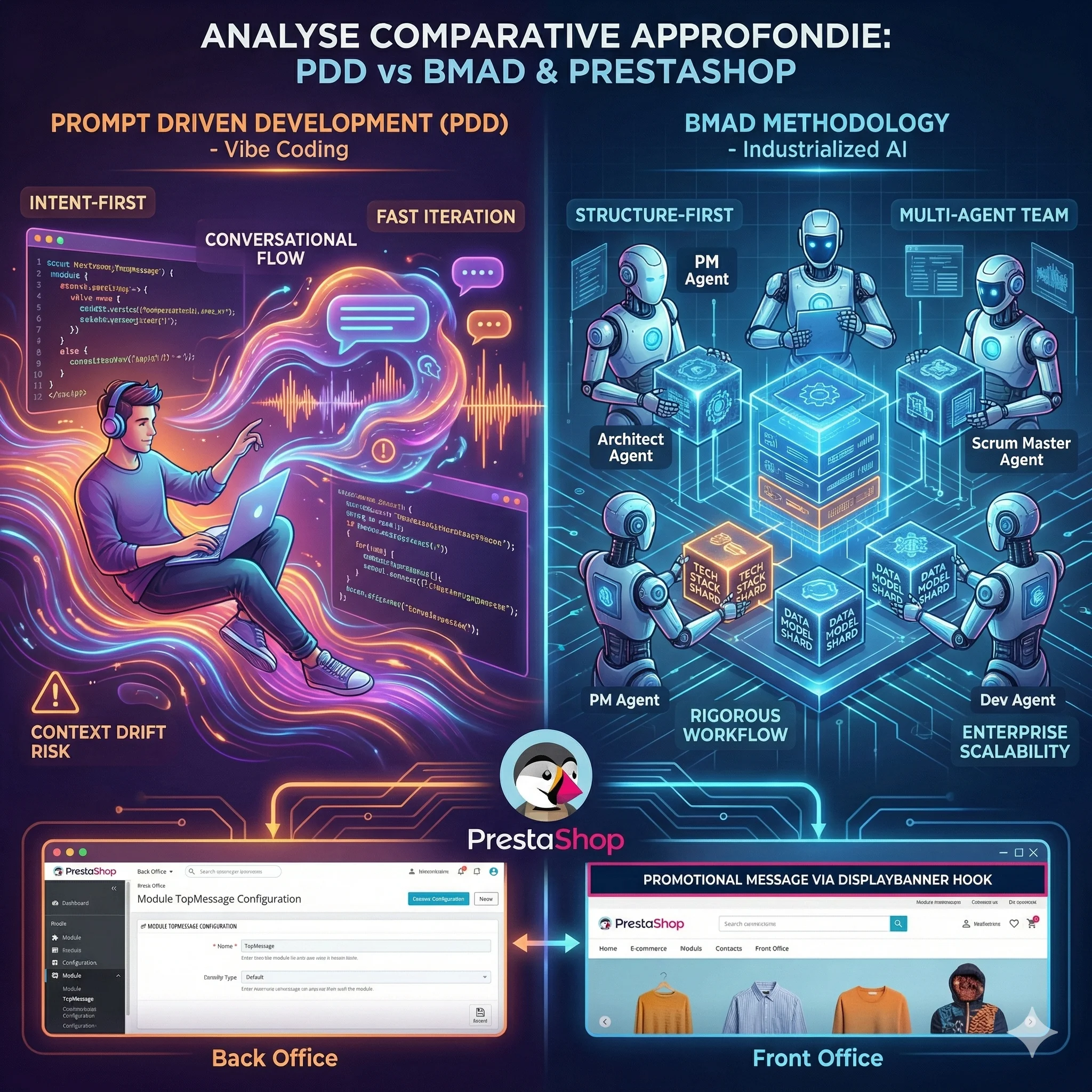
Analyse Comparative Approfondie des Paradigmes de Développement IA : Prompt Driven Development vs Méthodologie BMAD
L'avènement des Grands Modèles de Langage redéfinit le développement logiciel. Deux écoles s'affrontent : le Prompt D...

MIRROR et Engram : Comment l'IA Apprend à Penser et à Se Souvenir
Les modèles de langage actuels oublient, se contredisent et recalculent sans cesse ce qu'ils devraient simplement se ...

Plus Que des Prompts : 5 Révélations sur les Skills de Claude qui Vont Changer Votre Façon de Travailler
Découvrez comment les Skills de Claude transforment l'IA d'un simple assistant en un agent autonome capable d'apprend...

Analyse Stratégique Globale : Les Tensions Structurelles sur le Marché de la Mémoire Vive (RAM) et du Stockage en 2026
L'année 2026 marque une rupture fondamentale dans l'industrie des semi-conducteurs. La mémoire n'est plus une commodi...
Découvrez mes autres articles
Guides e-commerce, tutoriels PrestaShop et bonnes pratiques pour développeurs
Voir tous les articles