🎁 Perplexity PRO offert
🧠 Introduction
You might have been quietly refactoring a module or configuring an n8n workflow when the news dropped. And what news!
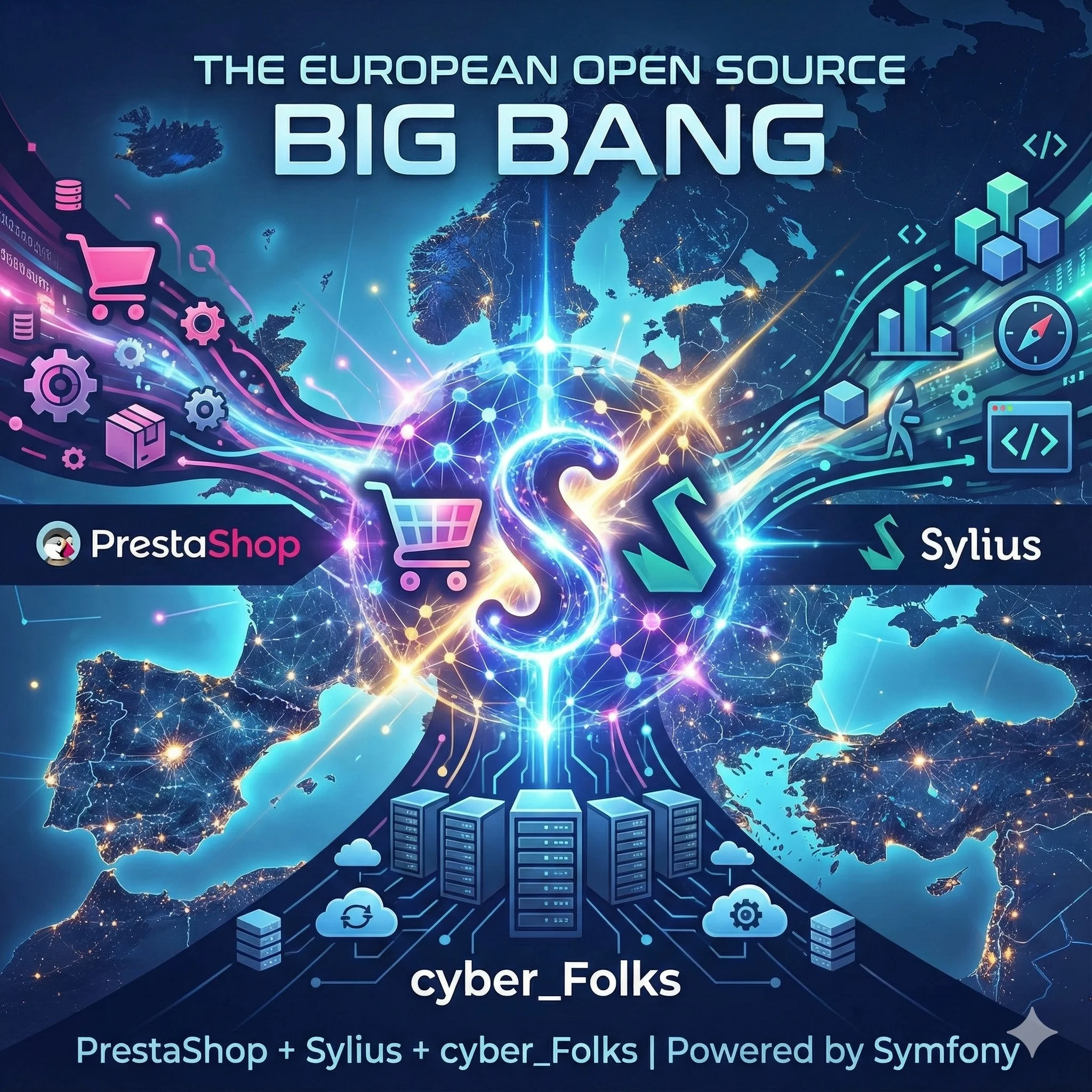
cyber_Folks, together with Sylius and BitBag, has just announced the acquisition of PrestaShop.
To be completely honest with you, my first reaction was surprise. Then, as I analyzed the details, that surprise turned into an excitement I hadn’t felt in a long time for our ecosystem.
We often hear that European Open Source is fragmented, that PHP solutions are losing ground to American SaaS giants (hello Shopify) or ultra-complex headless architectures. This announcement just swept those prejudices aside with the back of its hand.
What’s happening here isn’t just a financial buyout. It’s the consolidation of a technical and commercial force capable of redrawing the e-commerce map in Europe.
In this article, we’ll go beyond the simple press release. We’ll dissect why this PrestaShop + Sylius alliance is the dream scenario for us—developers and e-merchants—and how it will transform the way we work with the PHP/Symfony stack.
⚡ Part 1 – Context & Stakes: Unity Makes Strength (and Tech)
Why is this move so important right now?
The e-commerce market is at a crossroads. On one side, you have SMBs and micro-businesses that need turnkey solutions, quick to deploy and feature-rich (PrestaShop’s historical playground). On the other, you have the Mid-Market and enterprise accounts that demand total flexibility, decoupled architectures, and rock-solid robustness (Sylius’s DNA).
Until now, moving from one to the other was painful. A merchant who “exploded” on PrestaShop often hit a technical wall, sometimes eyeing Magento (too heavy) or custom development (too expensive).
The cast is perfect:
- PrestaShop: The volume leader. Powerful in the SMB segment, a massive community, and a transition to Symfony already well underway.
- Sylius: The technical elite. A “Developer First” solution, natively based on Symfony, agile and designed for complexity.
- BitBag: The field expert. An agency that masters both worlds and knows how to integrate these technologies.
- cyber_Folks: The fuel. A publicly-traded group that brings infrastructure, marketing tools (MailerLite, Vercom), and long-term vision.
The stakes are simple: Create a technological continuum. Instead of competing ecosystems, we now have a unified family around a common standard.
🚀 Part 2 – Analysis: Symfony’s Crushing Victory
This is where my developer and module creator hat comes alive. If we look under the hood, the obvious common denominator is Symfony.
PrestaShop’s Core Team has been working tirelessly for years to migrate the core to Symfony. It’s titanic work, sometimes thankless, but necessary. Meanwhile, Sylius is a standard Symfony application.
What this means technically:
-
Skills Convergence: The “PrestaShop” developer and the “Sylius” developer are no longer two different species. We’re all Symfony E-commerce developers. The learning curve to move from one to the other will collapse. The concepts are the same: Doctrine, Twig, Services, Events.
-
Module Interoperability: This is the Holy Grail. Imagine developing business logic (for example, a logistics connector or AI integration) encapsulated in an agnostic Symfony Bundle. With a bit of abstraction, this same code could run on both PrestaShop 9 and Sylius.
-
Quality and Testing: Sylius is renowned for its code quality and test coverage (Behat, PHPSpec). The influence of BitBag and Sylius on PrestaShop’s technical roadmap will inevitably raise the bar on quality. We can expect stricter code standards and a greatly improved DX (Developer Experience).
Technical note: With over €31 billion in GMV and 240,000 stores combined, this alliance creates the largest Open Source e-commerce data hub in Europe. For those of us working on AI, it’s an invaluable treasure trove of collective intelligence for training recommendation or prediction models.
🧮 Part 3 – Practical Application: Growth Scenario
Concretely, what does this change for your business or your clients tomorrow morning? Let’s take a real scenario.
The “FashionScale” case Imagine a clothing brand, FashionScale, that’s launching.
Phase 1: Launch (0 - €2M revenue) They choose PrestaShop.
- Why? Because there are 5000 ready-to-use modules. They install a theme, payment modules, shipping modules, and our tracking or AI modules for SEO.
- Cost: Low. Time-to-market: Immediate.
Phase 2: Acceleration & Internationalization (€2M - €10M revenue) The brand is growing. They need complex workflows, advanced multi-warehouse management.
- Before the acquisition: They would have started “hacking” PrestaShop’s core, creating technical debt, or thrown everything away to go to Shopify Plus (and lose ownership of their data).
- Now: They stay in the ecosystem. Agencies (like BitBag or French partner agencies) can introduce Sylius components to handle specific parts (e.g., an ultra-fast headless checkout) while keeping the PrestaShop back-office for the catalog.
Phase 3: Maturity (€10M+ revenue) They switch to a 100% Sylius architecture or advanced hybridization.
- Thanks to the common technical DNA (Symfony), migrating data and business logic is smooth. Internal developer teams don’t need to be replaced; they simply level up on the framework they already know.
🛠️ The opportunity for developers (you & me): This is the time to invest heavily in mastering Hexagonal architecture and Symfony patterns. If you create modules, start thinking “Decoupled”. Don’t code in PrestaShop anymore, code for e-commerce, and plug your code into PrestaShop. Tomorrow, that same code will be your gateway to the Sylius ecosystem.
🌍 Part 4 – Vision & Future Impact: Europe Strikes Back
I’m a tech optimist. Seeing Europe organize itself like this gives me a lot of hope.
We’ve often had an inferiority complex compared to American solutions. But look at the forces at play:
- Respect for GDPR and data sovereignty (a massive selling point today).
- A vibrant Open Source community that doesn’t depend on the whim of a Silicon Valley CEO who decides to raise prices by 30% overnight.
AI’s Impact in This Merger With cyber_Folks’ arrival and their arsenal (Apilo, SellRocket), I predict much deeper native AI integration. Imagine a unified “E-commerce Co-pilot” that analyzes your PrestaShop sales and automatically drives your email campaigns (Vercom/MailerLite), while optimizing inventory via Sylius algorithms.
The developers who will succeed tomorrow won’t be those who just know how to “make a module.” They’ll be those who know how to orchestrate these building blocks. Those who will use AI to generate unit tests for their PrestaShop to Sylius migration. Those who will connect these platforms via robust APIs.
The ecosystem is becoming more coherent, therefore more scalable.
🎯 Conclusion
This acquisition is much more than a financial line in a business journal. It’s validation that PHP and Symfony are the undisputed standards of modern e-commerce in Europe.
For us developers, it’s an invitation to raise our game. The boundary between “tinkering” and “software engineering” is disappearing. PrestaShop brings the power of numbers. Sylius brings architectural excellence. cyber_Folks brings the means.
Europe is uniting, structuring itself, and preparing. And frankly, having a front-row seat to watch this and participate in it… is extremely exciting. 💪🇪🇺
My question for you: Do you see this merger as a chance to level up on your technical projects, or do you fear a complexification of the PrestaShop ecosystem?
To go further: Check out our guide on PrestaShop and Symfony architecture or explore how AI is transforming PrestaShop development.
Questions Fréquentes
What does PrestaShop's acquisition by cyber_Folks actually change?
This acquisition creates a technological continuum around Symfony, allowing merchants to grow from PrestaShop (SMBs) to Sylius (enterprises) without changing ecosystems. Developers benefit from skills convergence.
Why is Symfony central to this alliance?
Symfony is the industry-standard PHP framework. PrestaShop has been progressively migrating to Symfony since version 1.7, and Sylius is natively built on Symfony. This means a common codebase, facilitating interoperability and skill development.
Will my PrestaShop modules still work?
Yes, PrestaShop maintains its progressive compatibility strategy. This alliance strengthens the ecosystem’s long-term vision, ensuring better stability for existing modules while opening new possibilities.
Articles Liés
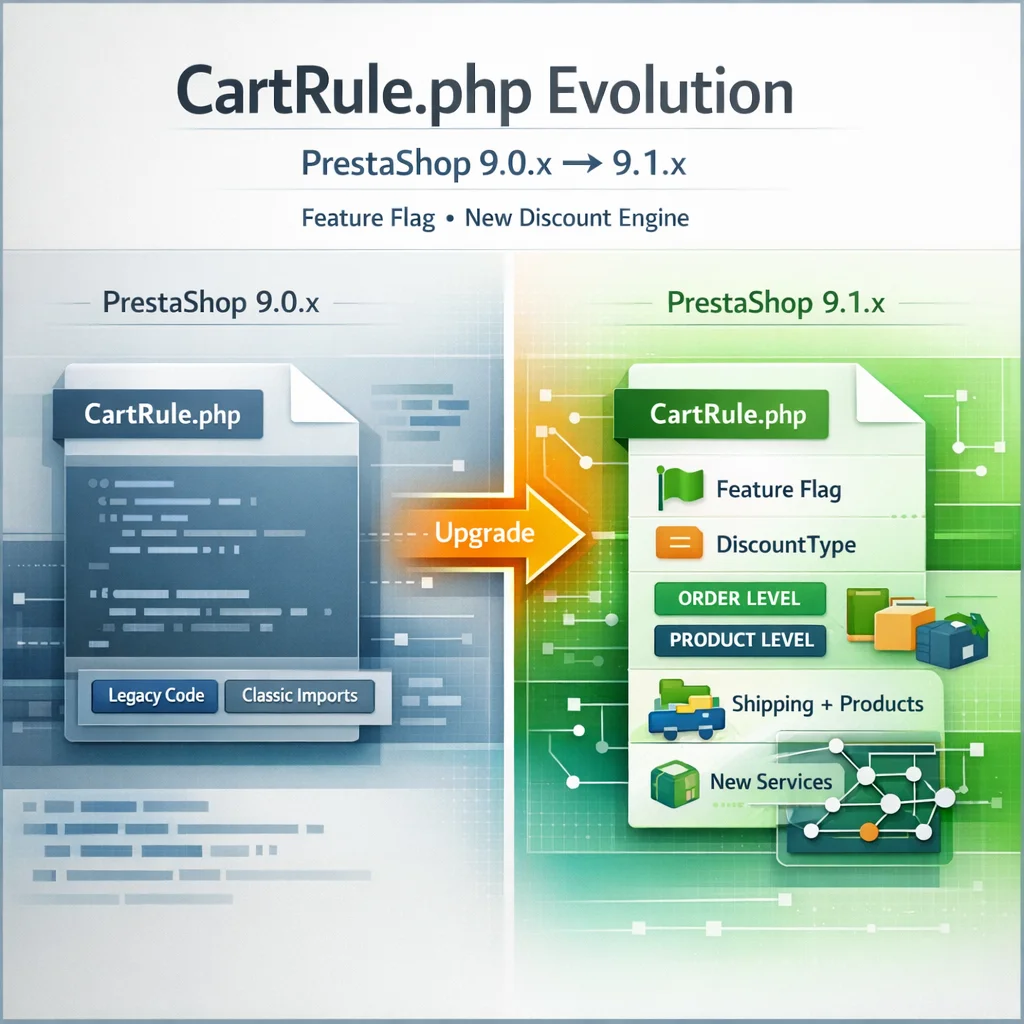
Évolution de CartRule.php : PrestaShop 9.0.x → 9.1.x
Analyse technique complète de l'évolution de CartRule.php entre PrestaShop 9.0.x et 9.1.x. Découvrez le nouveau systè...
💥 PrestaShop + Sylius : Le Big Bang de l'Open Source Européen
L'acquisition qui change tout : PrestaShop rejoint cyber_Folks et Sylius. 31 milliards d'€ de GMV, 240 000 boutiques,...
 Featured
GEO pour e-commercants : comment j'ai optimise une fiche produit pour apparaitre dans les reponses de ChatGPT, Gemini et Perplexity
Un cas pratique step-by-step : comment j'ai fait passer une fiche produit PrestaShop de 0 a 14 mentions dans les repo...
 Featured
Vibe Coding en e-commerce : pourquoi 80% des modules generés par IA ne passeront jamais en production
Le Vibe Coding révolutionne le développement, mais appliqué à PrestaShop, c'est un champ de mines. Exemples concrets,...
 Featured
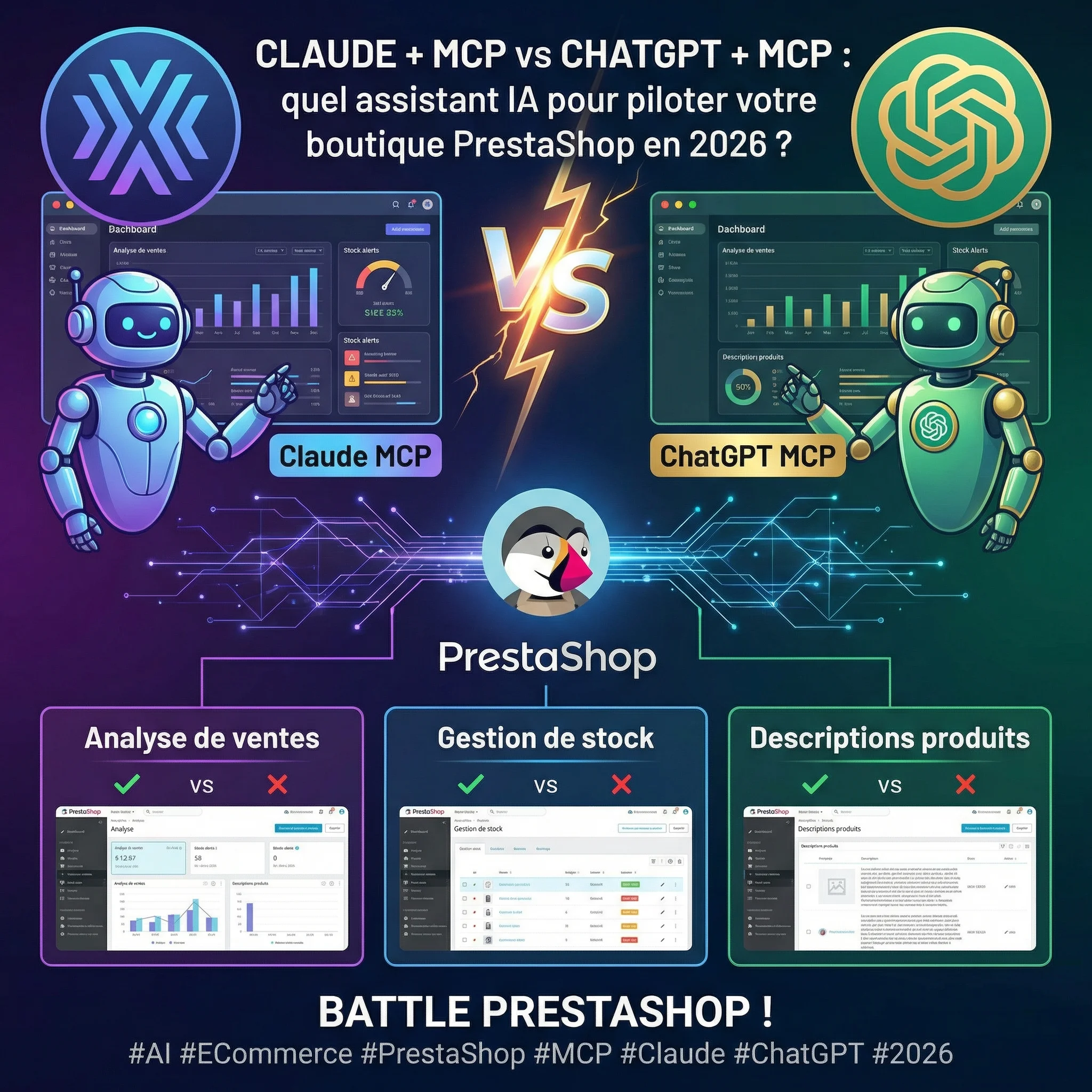
Claude + MCP Tools Plus vs ChatGPT + MCP Tools Plus : Quel assistant IA pour piloter votre boutique PrestaShop en 2026 ?
Claude ou ChatGPT pour gérer votre boutique PrestaShop ? Test comparatif réel avec MCP Tools Plus sur 5 épreuves e-co...
5 révélations surprenantes de la méthode BMAD sur l'avenir du développement de modules
La méthode BMAD révèle des enseignements inattendus sur le futur du développement de modules. De l'IA comme équipe pr...
Découvrez mes autres articles
Guides e-commerce, tutoriels PrestaShop et bonnes pratiques pour développeurs
Voir tous les articles