🎁 Perplexity PRO offert
📰 The AI Landscape at the Dawn of 2026
After a 2025 marked by the release of foundational models like GPT-5 and Gemini 3.0, the first quarter of 2026 appears less as a race for raw power and more as a crucial phase of consolidation and integration. Major players are pivoting towards ecosystems capable of acting, not just generating.
Here’s the state of play for Q1:
OpenAI: The Rise of Agents
Building on the deployment of GPT-5.1 last November, OpenAI is orienting its Q1 roadmap towards pure utility.
- Focus: Deployment of autonomous agents capable of orchestrating tools (calendar, payments, business systems).
- Expected innovations: Cross-session persistent memory (finally native) and direct commercial integrations to facilitate transactions.
- Strategy: Less “wow effect”, more reliability for enterprises.
Google: Silent Integration
Google continues its continuous deployment strategy. Gemini 3.0 (deployed under the 2.5 label at the end of 2025) is operational.
- Q1 2026: Likely arrival of Gemini 3.5 or an ultra-optimized Flash version to reduce inference costs.
- Ecosystem: Focus on deep integration into Workspace and Android, as well as the introduction of advertising in generated responses.
Anthropic: Reliability First
With Claude 4 (Opus and Sonnet) already well-established since May 2025, Anthropic aims for operational excellence.
- Roadmap: Introduction of native “Voice” and especially multi-agent coordination.
- Target: Companies seeking specialized agents (customer service, research) capable of collaborating with shared memory and autonomous conflict resolution.
Mistral AI: Sovereign Power
Mistral made a strong impact in December 2025 with Mistral Large 3 and its suite of dense models (Ministral).
- Performance: Large 3 now ranks #2 globally among “non-reasoning” models, surpassing DeepSeek.
- Q1 2026: Launch of a “Reasoning” version for Large 3 and especially a massive wave of integrations (Make, n8n, SAP, Stripe).
- Infrastructure: Confirmation of work on the European AI Campus (1.4 GW) for total infrastructure sovereignty by 2028.
🔍 Analysis and Context: The End of Experimentation
Why this transition now? We’re moving from the discovery phase into industrialization (LLMOps).
1. From Chatbots to Agents
The major trend this quarter is the shift from “Discussion” mode to “Action” mode. Models are no longer content to respond; they must execute complex workflows. For a developer, this means that the key skill is no longer prompt engineering, but agent orchestration.
2. The Battle for ROI and Regulation
Enterprise budgets are tightening. The time for fun POCs (Proof of Concept) is over; it’s now about measurable ROI. With the gradual implementation of the EU AI Act, traceability and explainability are becoming purchase criteria as important as model performance. This is where Mistral, with its Open Source approach (Apache 2.0) and sovereignty, plays a trump card against American black boxes.
3. Multimodality as Standard
Text, image, audio, video: pipelines are now unified. The ability to natively process video to extract structured data or code is becoming a commodity, opening the door to unprecedented e-commerce use cases (automatic product catalog analysis, technical sheet generation from supplier videos).
🎯 Practical Implications for E-commerce
For the PrestaShop ecosystem and merchants, these Q1 2026 developments open three immediate windows of opportunity:
Agentic Customer Service
With persistent memory capabilities (OpenAI) and multi-agent coordination (Anthropic), we can now deploy customer support that “remembers” a buyer’s history over several months, without hallucinating, and capable of triggering refunds or returns autonomously via API.
Business Automation via Mistral
The announced integrations of Mistral with tools like n8n, Make, or Zapier are a powerful lever.
Use case: A Mistral agent connected to your PrestaShop Back-Office that monitors inventory, drafts supplier orders, and prepares segmented newsletters based on arrivals, all hosted in Europe for GDPR compliance.
RAG 2.0 (Retrieval-Augmented Generation)
Improvements in contexts and “reasoning” enable the implementation of Graphical RAG systems. Instead of simply searching for keywords in your documentation, the AI understands relationships between your products (compatible accessories, collections). This allows creating shopping assistants on the storefront with formidable precision for cross-selling.
🌐 Perspectives
Q1 2026 is not the quarter of a disruptive technological revolution, but one of maturity. The technology is there; the challenge now lies in integration, security, and creating real added value.
For us developers and architects, it’s time to consolidate our infrastructures: move from isolated scripts to robust agentic architectures, and favor models whose lifecycle we control, like those offered by Mistral. AI doesn’t replace the profession; it becomes the nervous system that connects tools together.
📚 Useful Resources
Articles Liés
 Featured
La Grande Guerre des IA de 2025 : Chronique d'une Révolution qui Redéfinit le E-commerce et le Travail
L'année 2025 restera dans l'histoire comme le tournant décisif de l'intelligence artificielle générative. GPT-5, Gemi...

L'IA, le Pig Butchering et la Nouvelle Frontière des Arnaques : Pourquoi les Arnaqueurs Deviennent des Développeurs
Les technologies d'IA transforment l'une des plus anciennes formes de fraude : le pig butchering. Des LLM qui gèrent ...
Oubliez Python : Pourquoi PHP est le véritable avenir de l'IA pour le Web
Vous pensez que pour faire de l'IA, vous devez apprendre Python et les mathématiques complexes ? Faux. Python est le ...

L'avenir des développeurs avec l'IA
Le code n'est plus le seul langage du pouvoir dans le monde digital. Une nouvelle compétence, plus humaine et plus ac...
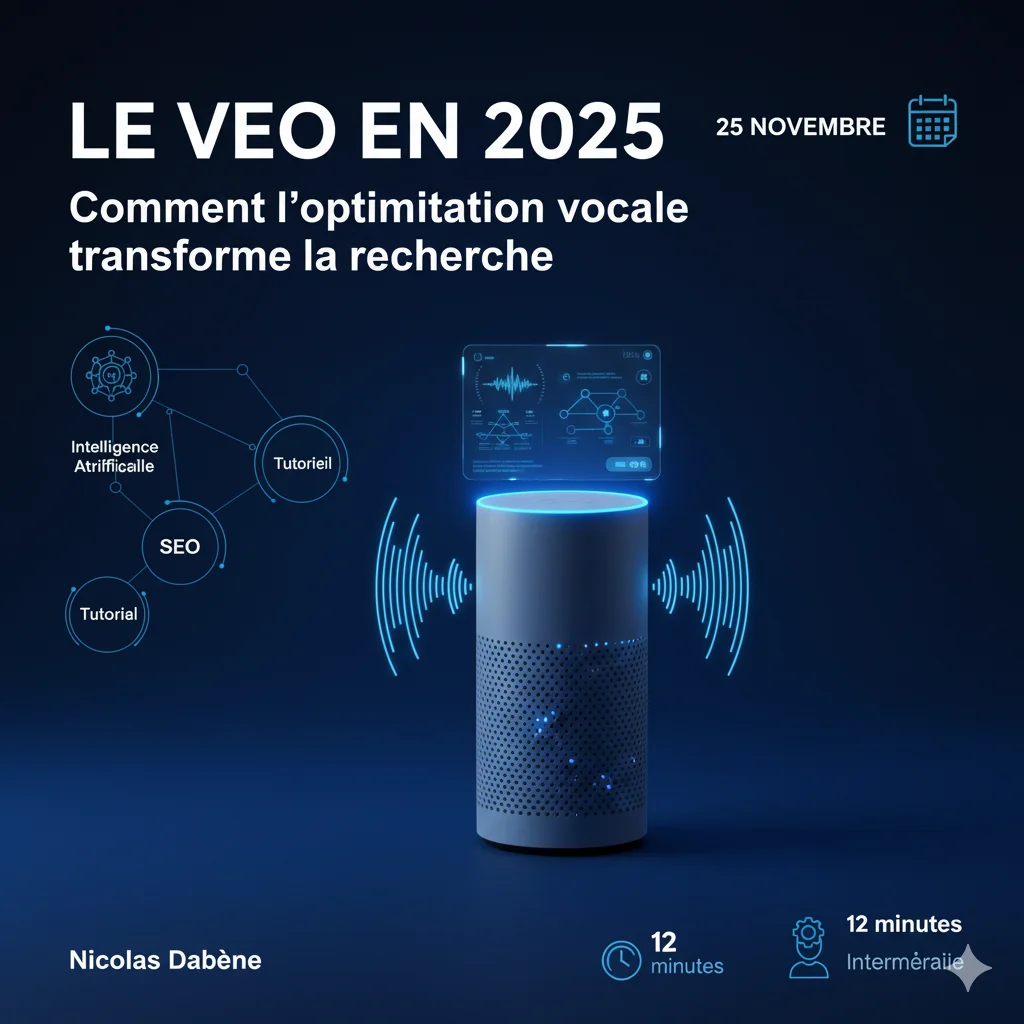
VEO 2025 : l'optimisation vocale transforme le SEO
L'optimisation vocale (VEO) transforme la recherche en 2025. Avec 8,4 milliards d'assistants vocaux actifs et 20% des...

L'IA est paresseuse : sa force cachée
Et si la révolution de l'IA reposait sur un immense malentendu ? Les modèles comme GPT ne "pensent" pas, ils évitent ...
Découvrez mes autres articles
Guides e-commerce, tutoriels PrestaShop et bonnes pratiques pour développeurs
Voir tous les articlesPlanification LinkedIn
Date de publication : 22 janvier 2026
Temps restant :