

🎁 Perplexity PRO offert
How many times have you had to develop (or purchase) a specific module to connect PrestaShop to a marketplace? One for Amazon, one for Cdiscount, another for Google Shopping…
Every time, it’s the same story: a proprietary API, temperamental OAuth authentication, and incompatible data formats. This is the “N x N integration bottleneck” problem. To connect everyone to everyone, you need an infinite number of bridges.
What if I told you that Google might have just blown the whistle on this exhausting game with the Universal Commerce Protocol (UCP)?
Imagine a world where your PrestaShop no longer speaks to a human interface (HTML/CSS), but directly to AI Agents (Gemini, ChatGPT) through a universal language. That’s exactly what’s happening now.
🌍 Part 1: From “Storefront” to “Agentic Commerce”
To understand UCP, we need to look at what happened with email. Today, it doesn’t matter if I use Gmail and you use Outlook: the SMTP protocol allows our messages to pass through.
In e-commerce, it’s the opposite. Amazon is a closed fortress. Shopify is another kingdom. PrestaShop is your independent castle. To exchange, you need to build expensive tunnels.
Google, in collaboration with giants like Shopify and Walmart, is launching UCP to standardize these exchanges. The goal isn’t to create a new marketplace, but to provide a common language (based on open-source standards like Beckn) so that any surface (a search engine, a chatbot, AR glasses) can:
- Discover your catalog.
- Check your stock in real-time.
- Place orders without ever taking the user to your storefront.
This is called Agentic Commerce. Your customer is no longer “John Doe clicking a button,” it’s “John Doe’s AI assistant negotiating JSON on his behalf.”
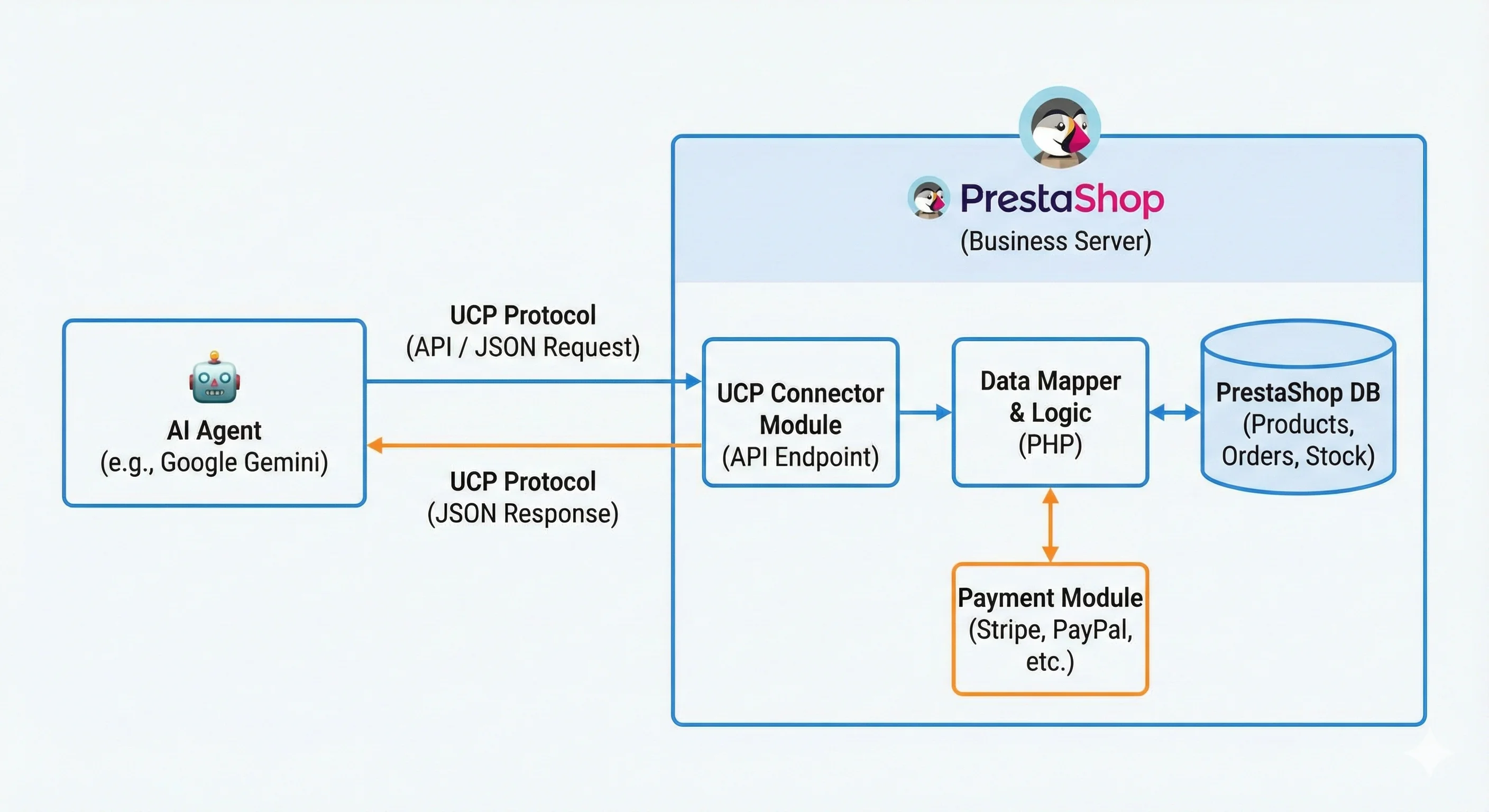
⚙️ Part 2: Under the Protocol’s Hood (Tech Deep Dive)
Concretely, UCP isn’t a platform, it’s a specification. For us PrestaShop developers, it looks like a standardized REST API but with a different philosophy.
1. The Discovery Manifest
Everything starts with a JSON file exposed at the root of your site, like a robots.txt on steroids: /.well-known/ucp.
It declares what your store can do:
{
  "ucp": {
    "version": "2026-01-11",
    "capabilities": [
      {
        "name": "dev.ucp.shopping.checkout",
        "spec": "https://ucp.dev/specs/shopping/checkout"
      },
      {
        "name": "dev.ucp.shopping.discount",
        "extends": "dev.ucp.shopping.checkout"
      }
    ]
  }
}
Google’s AI scans this file and thinks: “Okay, this site sells products and accepts checkout via the UCP protocol.”
2. The “Capabilities”
Unlike a monolithic API, UCP is modular. You expose “Capabilities.”
- discovery: To search for “Red shoes size 42.”
- checkout: To create a cart and pay.
- fulfillment: To manage delivery.
This is where it gets interesting for us: UCP separates the payment instrument from the processor. The AI can arrive with a payment token (generated by Google Pay on the user’s side) and transmit it to your store, which will process it via your existing Stripe or PayPal module, provided it’s UCP compatible.
🛠️ Part 3: PrestaShop as a “UCP Business Server”
This is where I put on my module architect hat. How do we transform a PrestaShop (designed in PHP to generate HTML Smarty/Twig) into a performant UCP server?
It’s not just an XML feed export. It’s synchronous transactional.
The Implementation Challenge
Google provides a Python SDK, but we’re in PHP. We’d need to imagine a “UCP Connector” module that would act as an abstraction layer (Wrapper).
The module architecture would look like this:
Frontend API Controller: A dedicated route /module/ucpconnector/api that listens to Agent requests.
Data Mappers:
- Convert
PsProduct(PrestaShop) ->Item(UCP Schema). - Convert
PsCart->Order(UCP Schema).
Strategic Hooks:
hookActionProductUpdate: To invalidate Agent cache if a price changes.hookActionValidateOrder: To inject the UCP order into the PrestaShop back-office as a “normal” order.
Logic Example (Pseudo-code)
Imagine a Gemini Agent requests a quote for a product.
// In your UCP Connector module
public function processQuoteRequest($ucpJson) {
    // 1. Decode the AI request (Search for product ID 12)
    $id_product = $this->mapUcpIdToPsId($ucpJson['item']['id']);

    // 2. Check PrestaShop stock in real-time
    $qty = StockAvailable::getQuantityAvailableByProduct($id_product);

    // 3. Calculate price (Cart rules, Customer groups...)
    $price = Product::getPriceStatic($id_product);

    // 4. Return response in strict UCP format
    return [
        'quote' => [
            'price' => [
                'currency' => 'EUR',
                'value' => $price
            ],
            'breakup' => [
                // VAT detail, shipping fees...
            ]
        ]
    ];
}
The major challenge? Performance. If Google’s AI queries your site, it expects a response in milliseconds. Forget loading unnecessary modules. You’ll probably need to use lightweight controllers or query directly in SQL for reads.
🚀 Part 4: Vision & Future Impact
Why should you care about this now, when it’s still experimental?
Because SEO is changing in nature. We’re moving from SEO (Search Engine Optimization) to AIO (Artificial Intelligence Optimization).
Tomorrow, being “first on Google” won’t mean having the best meta title anymore. It will mean having the fastest and most structured API so that Google Assistant can tell the user: “I found these sneakers at [Your Store], they’re in stock, and I can order them for you now with your Google Pay account. Shall I proceed?”
PrestaShop has a huge card to play. Its database structure is solid and standardized. If the community (or an editor like us) releases a robust UCP module, thousands of PrestaShop stores will instantly become “AI-Ready,” beating closed SaaS solutions that will take months to validate their roadmaps.
Conclusion: Prepare Your Data
The UCP protocol isn’t yet an industry standard, but it’s a strong signal. The future of e-commerce is decentralized and automated.
While waiting for UCP modules to arrive on the Addons Marketplace, your best investment remains the quality of your data.
- Valid EAN/ISBN codes.
- Clean attributes.
- Accurate stock.
Because when AI comes to shop at your store, it won’t forgive approximation.
And you? Ready to let robots place orders in your store? Let’s discuss on LinkedIn
Articles Liés

E-Commerce Cybersecurity Retrospective 2025: The Collapse of Certainties and the Specter of Vibecoding
An in-depth analysis of 2025, marked by unprecedented cyberattacks against French retail (Auchan, Boulanger, LDLC, Le...
 Featured
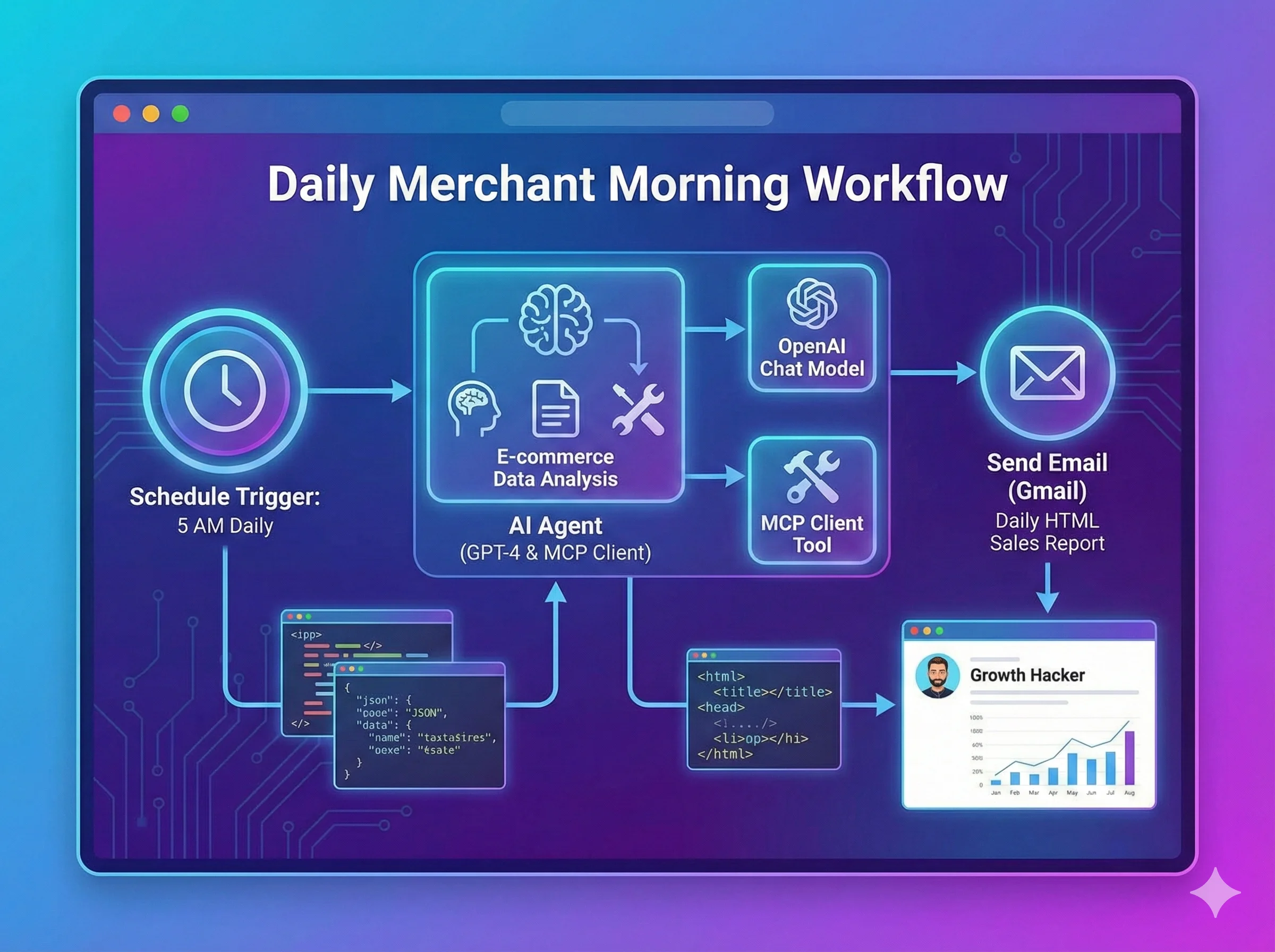
Fini le café devant Excel : Votre "Daily Merchant Morning" 100% automatisé avec PrestaShop et l'IA 🚀
Découvrez comment transformer votre routine matinale e-commerce en recevant chaque matin un briefing stratégique comp...
 Featured
La Grande Guerre des IA de 2025 : Chronique d'une Révolution qui Redéfinit le E-commerce et le Travail
L'année 2025 restera dans l'histoire comme le tournant décisif de l'intelligence artificielle générative. GPT-5, Gemi...
 Featured
Comment connecter un serveur MCP à Claude?
Le moment tant attendu : connectons votre serveur MCP sécurisé à Claude Desktop et voyons la magie opérer en conditio...
 Featured
PrestaShop rejoint cyber_Folks & Sylius : Le Big Bang de l'Open Source Européen (et ce que ça change pour vous)
C'est officiel : PrestaShop rejoint l'écosystème cyber_Folks aux côtés de Sylius. Ce n'est pas juste une acquisition,...
 Featured
Comment sécuriser un serveur MCP?
Votre serveur MCP fonctionne ? Parfait. Maintenant, sécurisons-le pour qu'il soit production-ready avec validation, p...
Découvrez mes autres articles
Guides e-commerce, tutoriels PrestaShop et bonnes pratiques pour développeurs
Voir tous les articlesPlanification LinkedIn
Date de publication : 14 janvier 2026
Temps restant :